"The Jews"
How do we talk about our Jewish neighbors?
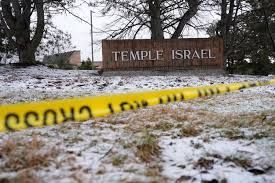
On Thursday, our kids' school was on lockdown, as a precaution, because in neighboring West Bloomfield a man drove a truck into a synagogue with a loaded weapon. The truck did damage as it made its way into the complex, and the building caught fire. The assailant was shot and killed by a security guard. One guard was hit by the truck but is expected to recover. Multiple first responders were treated for smoke inhalation. It could have been much worse than it was. But it should make us take a close look at how we talk about our Jewish neighbors, and how we hear our Scriptures talking about "the Jews."
It seems as though the assailant at Beth Israel was a Lebanese-born American citizen who lost family in the recent Israeli-American bombings in Lebanon. We will likely never know what went through his head. But the costs of war are more than dollars spent on munitions, property destruction, and lives lost. The deeper cost of war is the tearing apart of who we are as a people, as human beings and communities. Violence breeds violence because when violence touches those we love, inconsolable grief has the capacity to push any one of us to return violence for violence. That seems to be what has happened here. As Ghandi is supposed to have said, "An eye for an eye makes the whole world blind." At some point, we must reckon with the fact that our bombs and Israel's bombs invited this man to murder.
Still, this man chose violence. We cannot condone it, but we can try to understand it. He did not try to tear down the American or Israeli states; he was powerless against those powers. So he focused his rage on this particular synagogue. His wrath was, to say the least, misdirected. The people of Beth Israel did not drop bombs on Lebanon. And even if they support the state of Israel, they are not the perpetrators of the violence that took his family. But his desire for justice--for vengeance rather--got caught up in a larger pool of contempt: the fear and resentment of the Jewish people, the sway of Antisemitism. Antisemitism is a peculiar disease of our world, and through its strange logic real grievances against the Israeli state turn to the hatred of all Jews.
Jews were always somewhat distrusted in antiquity. The Assyrians destroyed the northern kingdom of Israel in 722 B.C. and Babylon destroyed the southern kingdom of Judah and Jerusalem in 586 B.C. The Babylonians took a number of the elite Judeans into captivity, into exile. Much of our Bible was collected and shaped by this experience of trauma, violence, and exile. The Jews gained some modicum of respect and autonomy under the Romans (though always under the hand of Caesar), but they always lived as resident aliens, as a wandering people. But the fortunes and fate of the Jews shifted decisively once Christianity came to imperial power, beginning in the fourth century A.D. From that point on Christian charity towards the Jewish people has been light on the ground. Christians have done more to rend and destroy Jewish communities and lives than anyone else. Christians have claimed, throughout the centuries, sometimes more softly, sometimes more vigorously (and violently), that Christianity replaced Judaism, that the Church replaced the Temple and Synagogue, that because Jews are Christ-killers, they have been abandoned by God and deserve to be punished. But all of these claims are, frankly, heretical. So, why has anti-Judaism and anti-Semitic "replacement theology" festered and spread among Christians?
There's no easy answer, except that violence breeds violence. When Christianity began it was entirely Jewish. Jesus was a Jew. Jesus's first followers were Jews. The earliest apostles were Jews. Paul was a Jew. They all prayed to the God of Israel, the one Jesus called Father. The Scriptures were the Jewish Scriptures (what we call the Old Testament). In its beginnings, Christianity was a kind of Judaism. (Arguably, it still is, but that's a conversation for another time.) But devotion to Christ took hold not primarily among Jewish communities, but among non-Jewish (or Gentile) communities. Through a difficult process, early Christians found themselves separated from their Jewish kin, even excluded from the synagogues and other Jewish places of prayer. They were left exposed to the whims of their (often uncharitable neighbors). And the pain of that exclusion and separation, and undoubted violence, left a mark on the early Christians writings that are now in our New Testament.
This is especially true of the Gospels of Matthew and John--which brings us to the season ahead of us and our responsibility to understand what our Scriptures are saying. In the Gospel lessons from John and the Passion narrative of Matthew are infamous texts that have been used to foment violence against our Jewish neighbors, and yet we regularly read them in Lent and Holy Week. John constantly talks about "the Jews" as a group opposed to Jesus. The Gospel lesson for this Sunday uses this language--"The Jews did not believe that he had been blind...; His parents said this because they were afraid of the Jews; for the Jews had agreed that anyone who confessed Jesus to be the Messiah would be put out of the synagogue" (John 9:18, 22). This verse is a mirror of the situation of Christians in the late first century--they were apparently being turned out of the synagogues. Paul seems to indicate such things might have been done with some violence. But clearly by using this language John paints with a broad brush. Surely, he means something like the Judean leaders. And yet, he says merely "the Jews." Much as the assailant at Temple Israel, John has drawn under one category and condemnation those who were guilty and those who were not. In doing so, he left later generations of Christians a legacy of legitimating hatred of Jewish people in general.
Matthew is in some ways better, but includes one disturbing line, which we usually voice as a congregation on Palm Sunday. When Pilate decides to crucify Jesus, in Matthew's Gospel he says, "I am innocent of this man's blood; see to it yourselves." Matthew continues: "Then the people as a whole answered, 'His blood be on us and on our children!" (Matthew 27:24-25). This is where the "blood libel" finds its justification. It is entirely appropriate for all the people in the congregation to voice this response. Unfortunately, for most of the history of Christianity, this verse has been taken not to be an admission of the guilt of all of us, but of the Jews. Christians have taken this verse as justification for punishing the Jews and their progeny.
So, what do we do with all of this? Paul has some insight:"I ask, then, has God rejected his people? By no means! I myself am an Israelite, a descendant of Abraham, a member of the tribe of Benjamin. God has not rejected his people whom he foreknew" (Romans 11:1-2). He goes on: "I want you to understand this mystery, brothers and sisters, so that you may not claim to be wiser than you are: a hardening has come upon part of Israel until the full number of the gentiles has come in. And in this way all Israel will be saved, as it is written, 'Out of Zion will come the Deliverer; he will banish ungodliness from Jacob.' 'And this is my covenant with them, when I take away their sins.' As regards the gospel they are enemies for your sake, but as regards election they are beloved for the sake of their ancestors, for the gifts and the calling of God are irrevocable" (Romans 11:25-29).
The Jewish people are God's people, and we have been grafted into the covenant God has made with them. There is no blanket condemnation of the Jews; they have not been replaced as God's chosen people. The painful separation of the early Christians from the Jewish community left its mark on the Christian story, and we have much to atone for. We must resist the notion that our Scriptures condemn the Jewish people in perpetuity. We must understand our own fear and grief lest we find ourselves enslaved to our bitterness, to our contempt, to violence.
This can be for us a lesson in what God's kingdom looks like. It is not a kingdom that counsels condemnation, but reconciliation. It is not a kingdom maintained through violence, but through sacrifice and long-suffering love. It is not a kingdom that pushes out and holds down our fellow humans, but one in which the poor, the lowly, the grieving, bruised, and beaten are raised to new life, restored to wholeness, and the mighty ones are brought down to their knees to serve and heal. May we hold onto this vision of God's kingdom until we find that we have no more enemies, until we find that we have awoken in the peace of God.
And as we walk through the rest of Lent and Holy Week, let us hold these lessons close to our hearts so that we might even reckon with our own complicity and so perhaps find forgiveness and healing. Let us pray for the peace of all God's children. For the gifts and the calling of God are irrevocable.