God's Grandeur
Over the bent world broods
During the pandemic, most of us tried new things, or even just mildly distracting things. To keep ourselves occupied. Two of my favorite preoccupations in the early days of COVID were to watch the back catalog of the Globe Theater and checking in with the latest offering from Sir Patrick Stewart (yes, Captain Picard from Star Trek: The Next Generation). During the pandemic he took to recording himself reading one Shakespearean sonnet per day. (I'm sure he did not think he would get through all 154 when he started!) At any rate, in April of 2020 I remember seeing that April is apparently poetry month. So, I recorded a short video of me reading a poem and posted it to Facebook. A small, very pandemic sort of thing to do. But if you've never taken the time to recite poetry out loud, even if only to yourself, you really ought to give it a try. (And before you try to tell me poetry isn't for you, I'll just say I think poetry is for everyone.; it just takes a little getting used to.) Anyway, the poem I read was "God's Grandeur" by Gerard Manley Hopkins (1844-1889). And it is worth revisiting in the light of Sunday's celebration of Pentecost.
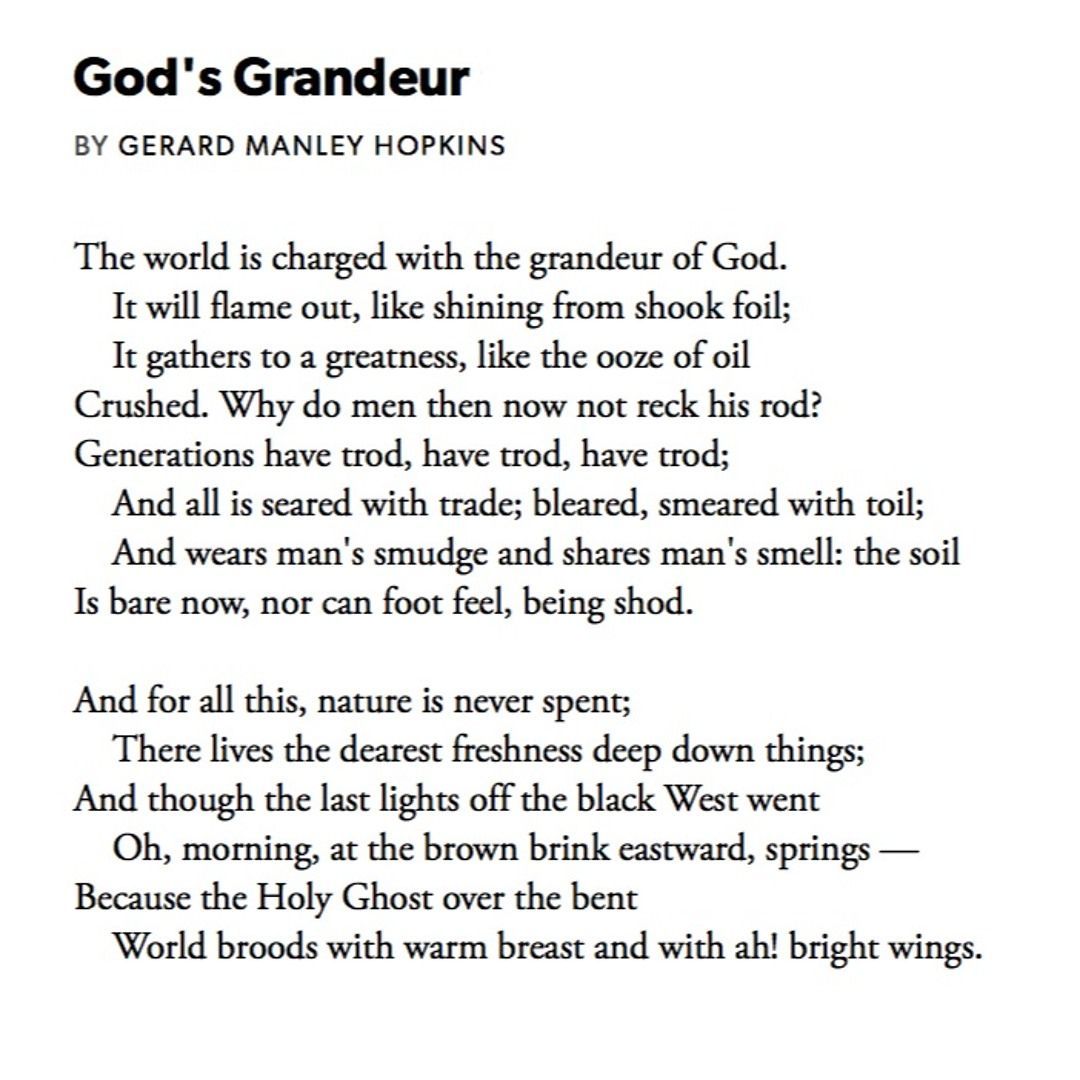
I love this poem so much. Hopkins is fun to read, full of unexpected turns of phrases which tumble almost out of control, but as it turns out, were extraordinarily well-wrought. Try to say this line out loud, "Why do men then now not reck his rod?" and you'll see what I mean, I think.
Part of what I love about this poem is its honesty before both divine mystery and human cruelty. It is true that the world is charged with the grandeur of God, and also that "all is seared with trade; bleared, smeared with toil; / and wears man's smudge and shares man's smell: the soil / is bare not, nor can foot feel, being shod." That is, the world we live in is bursting with the Love we call God, and also the world we live in is smeared and mired and we are in danger of becoming unfeeling.
And, Hopkins goes on to say, "for all this, nature is never spent." The world that God created remains beautiful and rich, alive with the hum of life. "There lives the dearest freshness deep down things." In the deep of every thing there is the dearest freshness, there is a life that is not always obvious. Underneath and behind and above and in and through everything is that Joy that we call God. Hopkins here marries two ideas. First, creation is glorious, shot through with the presence of God; it is very good. Second, while the world we see is bleared, smeared, there is reason to hope, because nature is never spent. God's creation does not really grow old, but only ever new.
Which brings us to the last verses and Pentecost. On Pentecost we commemorate the coming of the Holy Spirit to the disciples from whom Jesus had ascended. Or, the Spirit he breathed onto them.. But this Spirit is Christ and is the Ancient of Days, and proceeds from the Godhead through the Son and...where? Pentecost commemorates the coming of the Spirit, which is also to say, the blowing of the Spirit of God among us still. And this is more than a neat religious experience, because the Spirit does not so much come to rest in us and pull us along into its effluence, into the rhythms of God's own breathing. And this is why nature is never spent--because God has not ceased breathing, and never will. Life is constantly being breathed into us, hover over us. That's what Hopkins means when he says "And though the last lights off the black West went"--when all around seems dark--"Oh, morning, as the brown brink eastward, springs." A light glows on the edge of the darkness. And why? "Because the Holy Ghost over the bent \ World broods with warm breast and with ah! bright wings." That's an image worth pondering--like a mother hen, the Holy Ghost broods over our world. The Spirit of Life broods over this bleared, smeared, heartbreaking, soul-crushing, blood-letting world, this miraculous, grand, beautiful, glorious world, not as a watchful predator, like a falcon or eagle, but as a mother: with warm breast and with ah! bright wings. The Holy Spirit mothers the world into what is good and true and beautiful, and hovers over it to protect it and to sweep in the light that may seem to us to have faded.
After all, the world is charged with the grandeur of God.