Humanity's Grandeur
Pope Leo on the challenges of our times
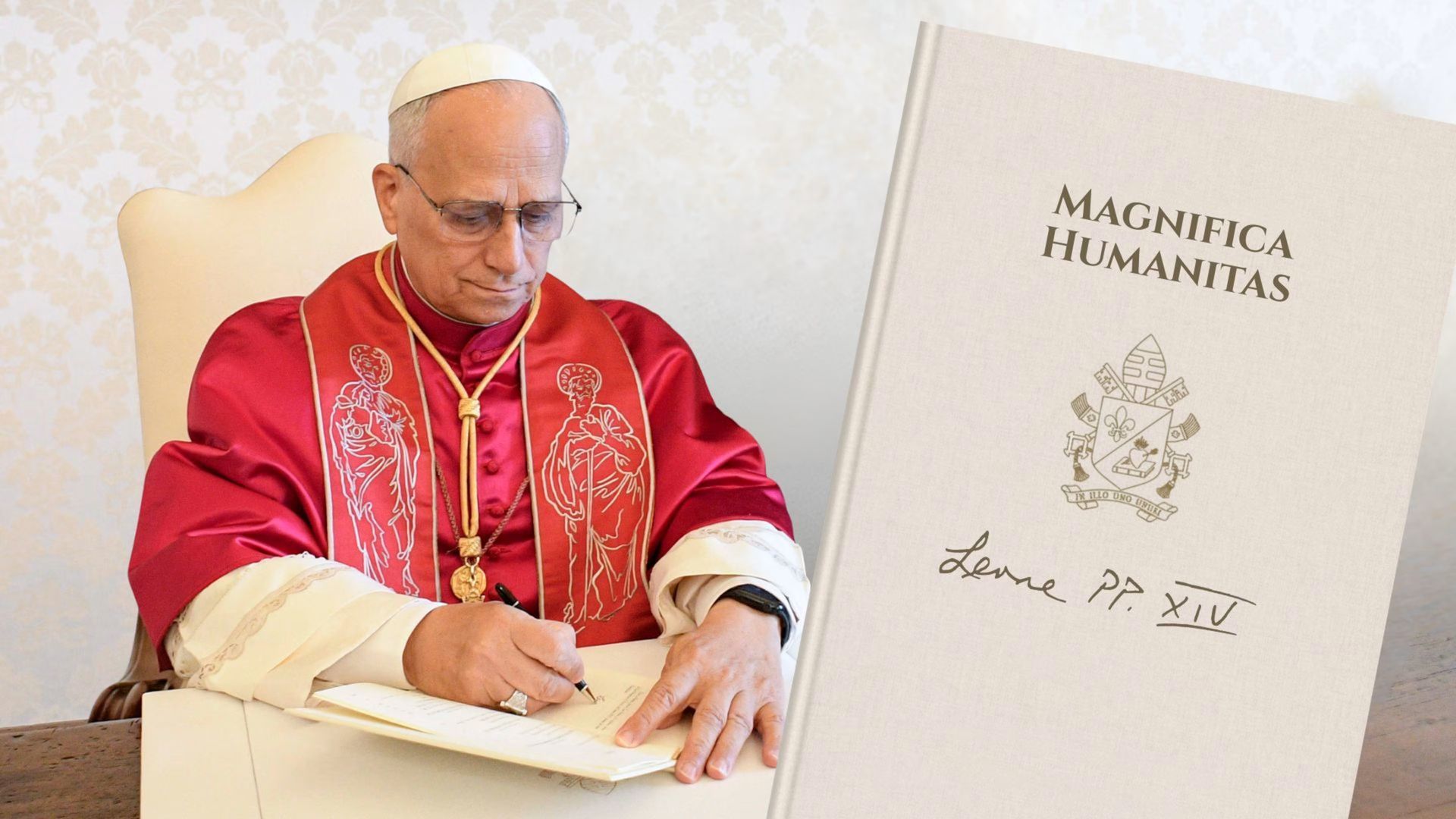
One of the gifts of the papacy is regular teaching and discernment about what it means to live as Christians and be the Church in the world, in the form of pastoral exhortations and "encyclical" letters. This week, Pope Leo XIV, the first Pope from America, issued his first encyclical letter, and it's a good one. It's title is "Magnifica Humanitas," (PDF here): Magnificent Humanity. The Pope writes about safeguarding the "grandeur of humanity" in an age of AI, of the moral and social vision of Christianity in our dehumanizing times. Since I wrote about the grandeur of God last week, this week let me offer a few thoughts on the Pope's encyclical on the grandeur of humanity.
Let's start here: The Episcopal Church is a part of the Anglican Communion. We began as the Church of England in the American colonies. The Church of England separated itself from the Roman Catholic Church under Henry VIII in the early sixteenth century, when the English Parliament declared Henry--not the Pope--the Head of the Church in England. The earliest Prayer Books of the Anglican tradition (and in the "Historical Documents" of our current Book of Common Prayer, pp. 867-876) contain an early statement of Anglican belief and practice in thirty-nine articles. The original version of Article 37 includes the following notice: "The Bishop of Rome hath no jurisdiction in the Realm of England." It may be that the Bishop of Rome--the Pope--"hath no jurisdiction" over the Episcopal Church and that the Pope has no canonical authority over our churches. But that freedom from the Pope's ecclesial authority actually gives us the gift of being able to listen to the Pope's teaching with open ears. And it is right and good that we do so. Even if the Pope "hath no jurisidiction" over us, we still stand to learn much from the spiritual guidance of the Bishop of Rome.
Pope Leo XIV took his name in homage to Pope Leo XIII, whose legacy in his encyclical Rerum Novarum is his teaching on the value of labor and the protection of workers from the excesses of capitalism. In Magnifica Humanitas the current Pope Leo writes to defend the grandeur of humanity in the face of the dehumanization of individuals by the excesses of the "digital revolution": manipulation of data by tech corporations who monopolize people's information for the sake of profit and power, the perils of AI, and the returning scourge of war.
Leo begins by summarizing the Social Doctrine of the Roman Catholic Church, and the consistent principles of Catholic social teaching: the common good, the universal destination of goods, subsidiarity, solidarity, and social justice. In brief, the goal of Christian engagement in the world is to secure the common good, the flourishing and recognition of the dignity of every human being: "It is the pursuit of the common good that gives life to a people, understood not as a mere collection of individuals, but as a living reality in which people learn to recognize that they themselves are interconnected and jointly responsible for the res publica" (62). As part of this goal, those things that we identify as goods (property, wealth, etc.) are intended for all persons, not to be monopolized by a few: "Today, among the goods that are universally intended for everyone, we must also include new forms of property, such as patents, algorithms, digital platforms, technological infrastructure and data" (67). Subsidiarity entails the regulation of the control of goods so that it is not only the high-level corporate agents who control decision making, but rather forms of cooperation that allows for local and regional agency in the accessibility of such goods, and solidarity requires that no one be left behind: "Solidarity...is the concrete recognition that the future of each individual is connected to the future of all; indeed, 'no one is saved alone'" (73). Finally, "justice is not merely about the fairer distribution of resources or the correction of current injustices, but also assumes a restorative dimension. ...This may include restoring dignity and a voice to those who have been ignored, fostering processes providing concrete support to those who still bear the consequences of wrongs suffered in the past" (79).
It is impossible to summarize the whole of Leo's argument. In the course of the encyclical Leo consistently upholds what we affirm in our baptismal covenant: the dignity of every human being. Along the way, he notes the need to protect the dignity of migrants, the dangers of bellicose political actors and concentrated military power in the hands of a few, the danger of AI being used to erode truth, and the risk of new tech undermining the value of human labor, he apologizes for the role of the Church in the trans-Atlantic slave trade, and he even quotes Gandalf from Tolkien's Lord of the Rings.
Above all, Leo encourages, invites, and presses us to build a better world, not a world in which we live for our own selves, building a Tower of Babel, but rebuilding the Temple, a world that is animated by communion. And he concludes with the example of St. Mary: "The Blessed Virgin Mary not only teaches us to recognize God's invisible work, but also directs our gaze to 'the points at which humanity is broken and the world becomes distorted; the contrast between the humble and the powerful, the poor and the rich, the satiated and the hungry,' teaching us 'to look at the world from a lower position: through the eyes of those who suffer rather than the mighty; to view history through they eyes of the little ones, rather than through the perspective of the powerful; to interpret the events of history from the viewpoint of the widow, the orphan, the stranger, the wounded child, the exile and the fugitive.' ...With the same faith as Mary, let us become 'weavers of hope' in our world sharing who we are and what we have, so that the presence of Jesus may grow among us and his Kingdom take shape. In the humble fidelity of daily life, even the era of AI can become a time in which the Holy Spirit brings about the civilization of love in our lives. ...I entrust our desire to the Mother of Christ, to the Woman of the Magnificat, that she may guide our steps through this time of change and preserve in each of us true faith in the Gospel, so that we may bear witness to the grandeur of humanity, in which God has made his dwelling."
At any rate, I invite you all to read it, and to be stirred, challenged, and moved by Pope Leo's words.