Field of Dreams
The Eternal and America's Pastime
Baseball. The great American game. Baseball is certainly a sport full of superstitions, but is there any spiritual or religious meaning to it? Or is it just a game? There is an undeniable nostalgia and a mystique that attends baseball. Consider the 1989 film Field of Dreams, perhaps one of the best baseball films ever made. There's a spirituality to the film. The ghosts of great players appear from the cornfields of Ray Kinsella's Iowa farm to play baseball once again, legends brought back to life for the love of the game. There are voices that speak to Ray and to Terence Mann, the literary figure Kinsella seeks out and brings back to Iowa to experience the field of dreams, to reawaken his love of the game. Near the end of the movie, Mann encourages Ray with a stirring speech to keep to his plan:
Ray, people will come, Ray. They’ll come to Iowa for reasons they can’t even fathom. They’ll turn up your driveway, not knowing for sure why they’re doing it. They’ll arrive at your door as innocent as children, longing for the past. “Of course, we won’t mind if you look around,” you’ll say. “It’s only twenty dollars per person.” They’ll pass over the money without even thinking about it. For it is money they have and peace they lack. And they’ll walk out to the bleachers, and sit in shirt-sleeves on a perfect afternoon. They’ll find they have reserved seats somewhere along one of the baselines, where they sat when they were children and cheered their heroes. And they’ll watch the game, and it’ll be as if they’d dipped themselves in magic waters. The memories will be so thick, they’ll have to brush them away from their faces. People will come, Ray.
The one constant through all the years, Ray, has been baseball. America has rolled by like an army of steamrollers. It’s been erased like a blackboard, rebuilt, and erased again. But baseball has marked the time. This field, this game — it’s a part of our past, Ray. It reminds us of all that once was good, and it could be again. Oh, people will come, Ray. People will most definitely come.
As it turns out, there are theologians who have also found something special about baseball.
Stanley Hauerwas, for instance, was featured on Time magazine's cover in 2001 as "America's Best Theologian," and he has written from time to time about the virtues cultivated by baseball. But perhaps the most eloquent theological reflections on the game of baseball have been written by the philosopher and theologian, David Bentley Hart.
In 2010 Hart wrote a piece called "A Perfect Game," and then just last month he published another article, "Running in Circles." Both were about the significance of baseball. In "A Perfect Game" Hart he asked "What, after all, will the final tally of America's contribution to civilization be, once the nation has passed away (as, of course, it must)?" And his answer is that he hopes we will be remembered for having invented the perfect game. Hart is known to be quite a rhetorician, a real wordsmith. So he knows how to spin an argument like this one. He opens his argument by claiming that "until baseball appeared, humans were a sad benighted lot, lost in the labyrinth of matter, dimly and achingly aware of something incandescently beautiful and unattainable...but, throughout most of the history of the race, no culture was able to produce more than a shadowy sketch of whatever glorious mystery prompted those nameless longings." Hart goes on to contrast baseball to what he calls "the oblong game": "a contest played out on a rectangle between two sides, each attempting to penetrate the other's territory to deposit some small object in the other's goal or end zone." The oblong game would include football, to be sure, but also soccer, basketball, field hockey, and any number of other global sports. As he explains in "Running in Circles," the oblong game "is played by the clock, under the tyranny of the sand that pours through the hourglass, and it is enclosed on all four sides by inviolable boundaries that dictate the strictly guarded dimensions of play." The "oblong game" "wholly lacks baseball's angelic indifference passing of the moments, and certainly baseball's openness to the infinite that lies beyond the imposing but not inviolable barriers of the outfield walls."
Although he swears he's not being hyperbolic, it's clear that he is using his considerable rhetorical skill to make his point, that baseball has something to say to us about the way the human heart is put together in a vast universe. Baseball is, after all, a game of failure. Or, as Hart puts it: "No other game...is so mercilessly impossible to play well or affords so immense a scope for inevitable failure. We all know that a hitter who succeeds in only one third of his at-bats is considered remarkable, and that one who succeeds only fractionally more often is considered a prodigy of nature. Now here, certainly, is a portrait of the hapless human spirit in all its melancholy grandeur, and of the human will in all its hopeless but incessant aspiration: fleeting glory as the rarely ripening fruit of overwhelming and chronic defeat." Even more, baseball is a redemptive game.
The "oblong game" is militaristic, typically brutal, a game of limits rather than possibility. Baseball, on the other hand, conjures memory and casts our gaze toward a better horizon--they will most certainly come, Ray. As Hart says, "I do think that the displacement of baseball by the NFL at the center of American culture is indicative of a certain kind of spiritual sickness. In part, this is simply because it marks a movement away from the pastoral to the military in our shared imagination, and away from a lyrical celebration of grace and speed to a gladiatorial spectacle of physical prowess and brutality." Even more, it is indicative of a turn from a horizon beyond what we can now imagine--a future bigger than the past--and toward a resigned end that is bounded by only what we can see: "One of America's sins of the heart is its belief in itself as bearing a sacred vocation, a sacred destiny within time to become the kingdom on earth--or, as we like to say, the greatest nation in history. That is a sordid aspiration. ...To remember eternity and not merely the past, to remember God and not merely the call of destiny, is to be partially liberated from the brutality and idiocy of history. And, in its humble way, baseball really is a vehicle of reconciliation between simple recollection of the past and a transfiguring anamnesis of the eternal, experienced in the enchanted form of repeated cycles within repeated cycles, across an ever-widening expanse of years."
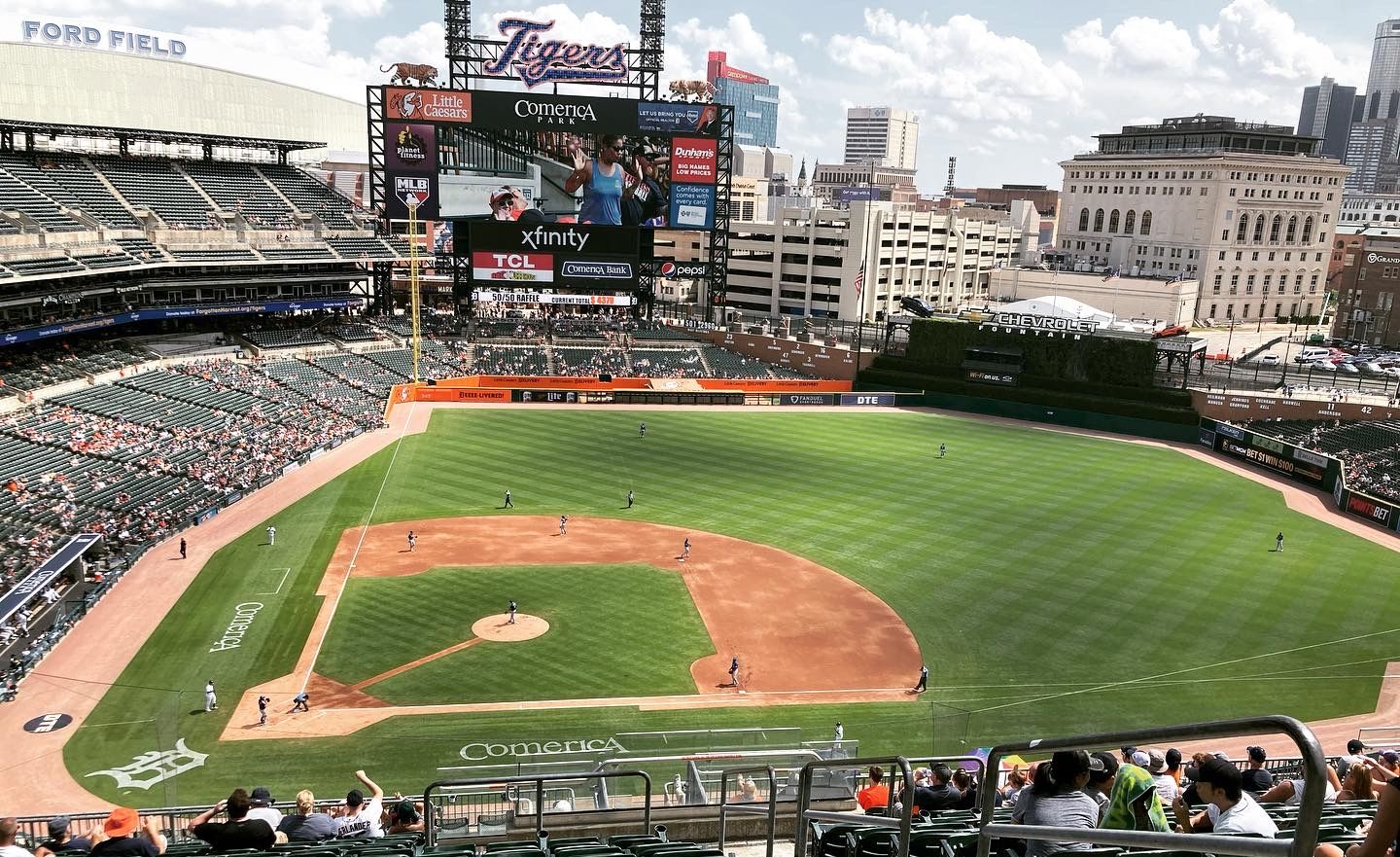
Ok. There's a lot to take in there, and invite you to read these two pieces for yourself. But for those of us taken by the game, baseball does represent something distinctly American and also something that evokes in us something of the eternal that isn't simply "churchy." Maybe baseball can remind us of what is deeper in the human heart than the desire to dominate. When we go to a baseball game, maybe we'll "walk out to the bleachers, and sit in shirt-sleeves on a perfect afternoon. We’ll find we have reserved seats somewhere along one of the baselines, where we sat when they were children and cheered our heroes. And we’ll watch the game, and it’ll be as if we’d dipped ourselves in magic waters. The memories will be so thick, we’ll have to brush them away from their faces. ...This field, this game — it’s a part of our past. It reminds us of all that once was good, and it could be again."
And if we're looking for something out in the world that reminds us of a sacred universe, maybe we'll find ourselves at a game--at a perfect, beautiful American game.
Oh, people will come, Ray. People will most definitely come.