
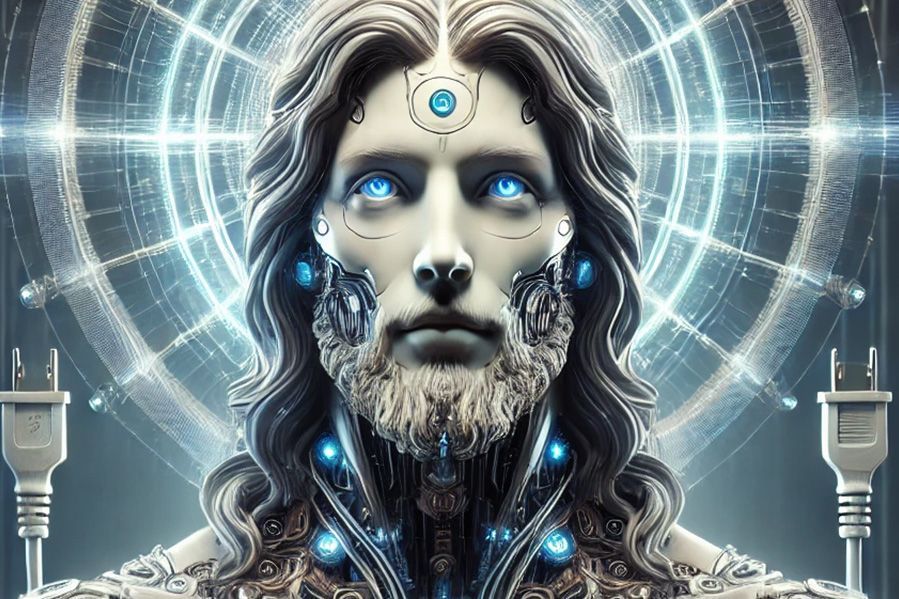
Pub Theology 11/18/25 -- Jesus ex machina
Peter Trumbore • November 17, 2025

Artificial intelligence (AI for the uninitiated) seems to be worming its way into more and more aspects of our daily lives. Or at least AI hype seems to be.


In high schools and colleges we have students using AI to do their homework, in the working world job-seekers are using AI to write and submit job applications while businesses use AI to read and evaluate those applications. Folks are using AI to plan their vacation itineraries, set fitness goals and create workout plans, write recipes, give them relationship advice, to take the place of therapists, and even as stand-ins for real world friends, confidants, or romantic partners. And now it's come for our churches.


Some years back in one of our pre-pandemic conversations, we talked about the role of technology in our faith lives, but at that time the most exotic application we had run across was a "virtual reality Jesus experience" that purported to let users walk alongside Jesus and the disciples through the Gospel narrative. That sounded pretty lame to all of us, including our resident VR enthusiast at the time. Let's just say the technology has ... moved forward ... since then.


Where VR Jesus offered a chance to walk with Jesus, new AI-based apps will let you talk with the Son of God, or at least a chatbot version of the Savior. The Text with Jesus app lets users ask questions of and converse with not just Jesus, but other biblical figures, from apostles to prophets. Apparently the premium version will unlock the ability to chat with Satan too.


Other AI-powered faith resources are out there too, including EpiscoBot, created for The Episcopal Church by TryTank, a research institute associated with the church's Virginia Theological Seminary. This draws on church resources and teaching to respond to faith-based and spiritual queries. For Roman Catholics, apps like One Day Confession and Confession -- Catholic (you can find them in the Apple App Store) help the faithful confession and spiritual reflection. And a California megachurch pastor has created an AI chatbot version of himself to provide one-on-one spiritual guidance, all for the low, low cost of $49 a month. We're not providing a link to that one.


What to make of all this? That's the topic of our conversation this week. To help you think about the issues, here's a link to an article just published in the UK-based web magazine UnHerd, written by a friend of mine, a priest in the Church of England. In it the Rev. Gerry Lynch writes that despite the perils and pitfalls, "Some churches will nonetheless become tempted by the AI hype. They should heed the lessons learnt during the pandemic, when online services and “virtual church” were presented as a God-sent means of Christian revival instead of a regrettable necessity in extreme circumstances." And here's another story on one experiment in having an AI Jesus hear confession at a Roman Catholic Church in Switzerland.


Join us for the discussion this Tuesday evening, Nov. 18, starting at 7pm at Irish Tavern in downtown Lake Orion. Word on the street has it that we may even reach out directly, or via text at least, with Jesus himself and see what the Redeemer of Mankind has to say.

By Andrew Guffey February 15, 2026
This Sunday, all are welcome to join us for a morning of worship and fellowship. Whether you are with us in the sanctuary or joining from afar, your presence strengthens our community. Our service is at 9:30 a.m. We warmly welcome those who cannot attend in person to join us via our live stream.
By Andrew Guffey February 13, 2026
Rem ember, you are dust.
By Peter Trumbore February 9, 2026
Every now and again we dip into the archives to bring back a topic from a past discussion. When you've been doing this for more than a dozen years, there's plenty of good stuff to revisit. So we're doing that this week, and it turns out to be a surprisingly timely decision. Next Tuesday marks Random Acts of Kindness Day (yes, really), and it turns out that nine years ago, almost to the very day, our conversation revolved around the idea of random acts of kindness. Since we last talked about it, the idea of random acts of kindness has become surprisingly institutionalized. According to the Random Acts of Kindness Foundation , which actively encourages just such things, "When we choose kindness, our brains light up with oxytocin, dopamine, and connection; reminding us that kindness is not just good for the world, it is good for us." And almost 250,000 people worldwide have signed up with the foundation as RAKtivists, pledging to try to make the world a better place one act of kindness at a time. For its part, the foundation, which aims to make kindness a norm, offers kindness tips and suggestions, creates teaching materials, and encourages kindness in our schools, homes, and in our workplaces. For example, when on social media they suggest: "Scroll until you see someone's creative effort -- a drawing, recipe, a photo -- and leave a genuine, specific compliment." To be honest, that sounds like a really nice idea! Here's the prompt from our discussion way back in 2017: In 1982 Anne Herbert wrote the phrase "practice random kindness and senseless acts of beauty" on a restaurant placemat in Sausalito, Calif. Since then, the call to practice random acts of kindness has become firmly rooted in our social culture. So what's an example of this? When's the last time you were on the receiving end of a random act of kindness? What did that feel like? When was the last time you performed one? How did that make you feel? Is such a gesture really meaningful, or is it a way to avoid making kindness a part of our everyday lives and routines? Join us for the conversation tomorrow evening, Tuesday February. 10 starting at 7pm. We gather at Irish Tavern in downtown Lake Orion.
By Andrew Guffey February 8, 2026
This Sunday, all are welcome to join us for a morning of worship and fellowship. Whether you are with us in the sanctuary or joining from afar, your presence strengthens our community. Our service is at 9:30 a.m. We warmly welcome those who cannot attend in person to join us via our live stream.
By Andrew Guffey February 5, 2026
Where Did Early Christians Think Their Borders Were?
By Peter Trumbore February 2, 2026
Just when I thought we had exhausted the possible universe of discussion topics about all the various and troubling ways that artificial intelligence technologies are promising to reshape the human experience (and rarely are these for the good) I come across another example that makes my head spin. This one is populated by what are called "deadbeats" being built by companies in what is coming to be known as the "digital-afterlife industry." There's a long article over at The Atlantic's website ( click here for a gift link to the story ) that goes into detail about the people and the companies developing the products that in some cases promise to make grief obsolete by giving users AI chatbot versions of deceased loved ones -- for a monthly subscription fee, of course. Or, in industry parlance, access to AI "deadbot" versions of those loved ones. And it seems that this is a lucrative technology. In 2024, the industry was valued at more than $22 billion, a sum expected to more than triple in less than 10 years. There are a lot of questions that emerge as we think about what all of this means for the way we experience grief and loss: "'Deadbots,' as these posthumous AI creations are known, promise to replace the dead, and the way they are remembered. This raises plenty of ethical issues, not least the extent to which turning deadbots into marketable products will rely on exploiting people in mourning. But perhaps the biggest question is how such a product might shift our experience of personal grief and collective memory. Is grief merely a painful human shortcoming that we haven’t learned to optimize our way out of yet, or does it have a purpose?" As the article makes clear, this technology is very different from the familiar ways we have come to memorialize those we have lost, whether through portraiture, literature, memoir, and so on, which are interpretive expressions of the living's memories of the dead. Instead, "Interactive griefbots are generative, producing “new utterances, new reactions, even new ‘memories’ and ‘behaviors,’ all under the guise of the deceased,” she said. This shift from representation to emulation presents a new ethical line, one that may require new legal protections. Both death and grief are states of profound vulnerability, she warned; the dead cannot stand up for their own interests, and the bereaved may not be in a psychological state to protect themselves from financial manipulation by a company incentivized to prolong their grief. One company, called You, Only Virtual, or YOV, says its point isn't to make grief easier, but rather to bypass it altogether. The company launched with the tagline, "Never have to say goodbye," and promises a user experience that will make you feel as if your loved one never died. In other words, they are promising not to capture every aspect of the person who has passed, but instead to capture how the user felt with that person when they were alive. The point of the interaction is "about inducing the emotions of the living, not imitating the emotions of the dead." We're going to talk about all of this in our conversation this week. Not just about the technology, but about grief itself, how we experience it, and what grief does to and for us. Read the article by clicking on the link above, then join us for the discussion this Tuesday, Feb. 3, starting at 7pm at Irish Tavern in downtown Lake Orion.
By Andrew Guffey February 1, 2026
This Sunday, all are welcome to join us for a morning of worship and fellowship. Whether you are with us in the sanctuary or joining from afar, your presence strengthens our community. Our service is at 9:30 a.m. We warmly welcome those who cannot attend in person to join us via our live stream.
By Andrew Guffey January 30, 2026
"...Rejoice always, pray without ceasing, give thanks in all circumstances..."
By Andrew Guffey January 25, 2026
This Sunday, all are welcome to join us for a morning of worship and fellowship. Whether you are with us in the sanctuary or joining from afar, your presence strengthens our community. Our service is at 9:30 a.m. We warmly welcome those who cannot attend in person to join us via our live stream.
By Andrew Guffey January 23, 2026
Sheep in the Midst of Wolves