Living With Uncertainty
What do we do when we don't know what to do?
On Sunday, I shared a quote by Thomas Merton, which he ends with this stunning statement: "Yet the fact remains that we are invited to forget ourselves on purpose, cast our awful solemnity to the winds and join in the general dance." To join the general dance, which is God's own dance and music and delight. "For the world and time" Merton says, "are the dance of the Lord in emptiness. The silence of the spheres is the music of a wedding feast." He sounds pretty assured of all of this. In his work, New Seeds of Contemplation, he talks about what contemplation is: "Contemplation is the highest expression of man's intellectual and spiritual life. It is that life itself, fully awake, fully active, fully aware that it is alive. It is spiritual wonder." Lovely. But what if we're not all saints who feel this spiritual wonder? What if some of us mere mortals have more doubts, more uncertainty than all of that?
As it turns out, Merton was no cheery optimist. His love of contemplation grew out of his practice, and that practice was not one of certainty:
For contemplation is a kind of spiritual vision to which both reason and faith aspire, by their very nature, because without it they must always remain incomplete. Yet contemplation is not vision because it sees "without seeing" and knows "without knowing." It is a more profound depth of faith, a knowledge too deep to be grasped in images, in words or even in clear concepts. It can be suggested by words, by symbols, but in the very moment of trying to indicate what it knows the contemplative mind takes back what it has said, and denies what it has affirmed. For in contemplation we know by "unknowing." Or, better, we know beyond all knowing or "unknowing."
For Merton, the art of contemplation, of breathing in and breathing out God, takes place not in the absence of uncertainty and unknowing, but precisely in the midst of uncertainty and unknowing. In his Thoughts in Solitude, Merton wrote about his profound uncertainty in how God was calling to him:
My Lord God, I have no idea where I am going. I do not see the road ahead of me. I cannot know for certain where it will end. Nor do I really know myself, and the fact that I think I am following Your will does not mean that I am actually doing so. But I believe that the desire to please You does in fact please You. And I hope I have that desire in all that I am doing. I hope that I will never do anything apart from that desire. And I know that, if I do this, You will lead me by the right road, though I may know nothing about it. Therefore I will trust You always though I may seem to be lost and in the shadow of death. I will not fear, for You are ever with me, and You will never leave me to face my perils alone.
People usually tack on an "Amen" at the end and call it Merton's Prayer of Uncertainty. But there's no Amen in the text itself. It's not really a formal prayer; it's just Merton speaking honestly to God with us in earshot. And it may be a prayer you find helpful and want to keep close at hand (it's one of those I keep on a clipping in my prayer book). Here Merton recognizes how much uncertainty we carry with us, if we're honest, and that God is with us precisely in that uncertainty.
As we continue our Lenten journey, let me give you permission to be uncertain. Our world would be a lovelier place, I truly believe, if more of us enjoyed our own uncertainty. There is a lot in the world that threatens to overwhelm us with the confusion and uncertainty of it all. But instead of trying to conquer it, Merton might ask us rather to sink into it, to feel our powerlessness before it all, so that God's own heart and power can come more solidly into view.
And that's what Merton means when he says we are invited "to forget ourselves on purpose," to "cast our awful solemnity to the winds." To overcome our uncertainty, we need to become less certain. "The more we persist in misunderstanding the phenomena of life," Merton writes, "the more we analyze them out into strange finalities and complex purposes of our own"--in other words, the more we try to muscle our way past our uncertainty--"the more we involve ourselves in sadness, absurdity and despair." It is our need for certainty that keeps us tethered to the idols that threaten to swallow us in an abyss of anxiety, sadness, absurdity, and despair--and usually those are idols of our own competence and self-sufficiency.
This same uncertainty hounded Dietrich Bonhoeffer, too. During his imprisonment by the Nazis, before he was killed for his allegiance to Jesus over the Fuehrer, Bonhoeffer wrote a moving poem (in his Letters and Papers from Prison), "Who am I?" The poem begins with observations those around him were making--about his cheerfulness and his charisma, his faith and his outward assurance. But he's not so certain:
Who am I? This or the other?
Am I one person today, and tomorrow another?
Am I both at once? A hypocrite before others,
and before myself a contemptibly woebegone weakling?
Or is something within me still like a beaten army,
fleeing in disorder from a victory already achieved?
Who am I? They mock me, these lonely questions of mine.
Whoever I am, thou knowest, O God, I am thine.
They mock us, these lonely questions of ours. But as Bonhoeffer sinks into his uncertainty, it's not despair that catches him. The same is true of Merton. Even when we begin to slide from uncertainty to despair, he says, "it does not matter much, because no despair of ours can alter the reality of things; or stain the joy of the cosmic dance which is always there. Indeed, we are in the midst of it, and it is in the midst of us, for it beats in our very blood, whether we want it to or not."
Uncertainty is not a flaw, not a bug in our design, but a feature. Our compulsive need for certainty is the flaw. Our need to be omni-competent, masters of our domain, masters even of our own selves--that's the flaw, because mastery is always illusory.
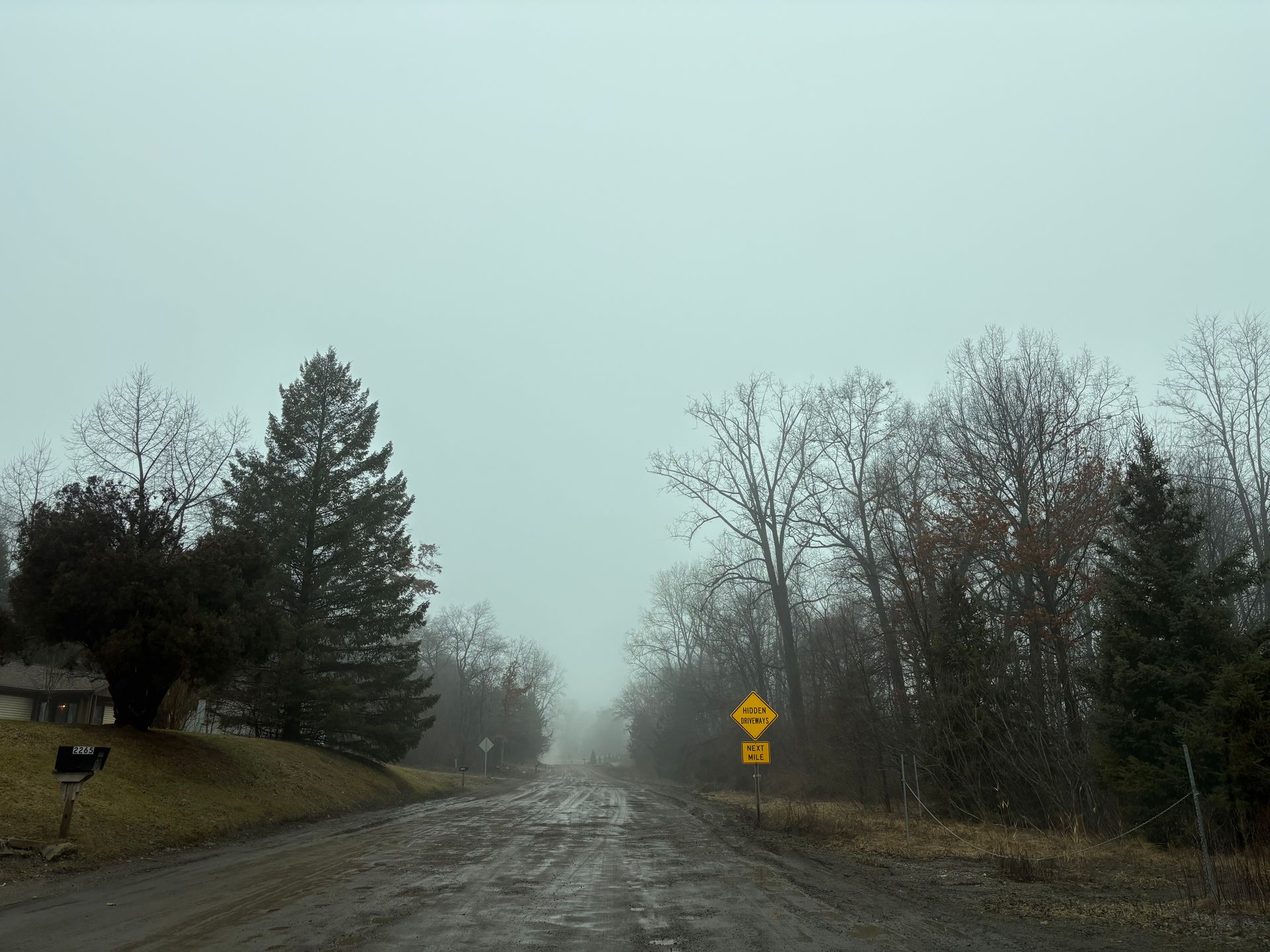
Do you find yourself uncertain how to walk through these days? Like walking through the thick fog that falls heavy around us today? Just as we find by walking through the fog that we see enough of the road ahead of us even if we cannot see it's end, and so we trust that we are walking in the right direction, so too we walk through our lives and uncertain times, trusting that by putting one foot after another, doing the next right thing as far as we can see--that by doing that, "even though we may know nothing about it," we may yet find the good road.