Common Prayer
A Primer on the Book of Common Prayer
I have a confession: sometimes I feel like I’m not encouraging the people of St. Mary’s to be very good Episcopalians. Not that I’m discouraging being good Episcopalians, but there is an aspect of our tradition as Episcopalians that is harder to maintain and promote in our historical moment. I’m referring to the practice of common prayer, and more specifically, the use of the Book of Common Prayer.
On Saturday, May 9, five of our youth will be confirmed in the Episcopal Church. To mark the occasion we presented each of them with a Book of Common Prayer (BCP). That’s because the BCP is one of the most distinctive marks of the Episcopal Church and the global Anglican Communion. Most churches have hymnals and Bibles in their pews. In any given Episcopal Church, like ours, one is more likely to find hymnals and BCPs.
So, what is the BCP? Where did it come from? Why has it been so important? And what should we do with it today? I thought maybe I should offer some initial thoughts on all of this. So, here’s a brief primer on the BCP.
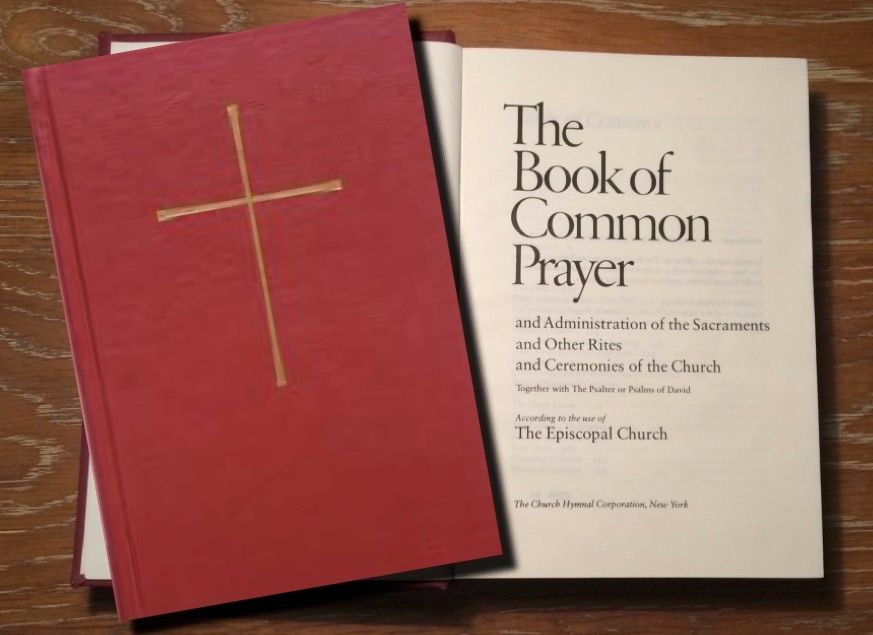
The first BCP was born during the English Reformation. As you may recall, during the sixteenth century, Christianity in the West (meaning, mainly Western Europe), went through a variety of transformations, or, as the leading proponents often called them, reformations. They did not set out to found new churches, but rather to reform the Church, to renew what had been forgotten, restore what had been lost, and to excise excesses.
Henry VIII, originally not a fan of Martin Luther, one of the principal reformers, eventually came to the conclusion that the Church of his realm needed some reform also, and with the help of select political actors and Cardinals established the Church of England as both continuous with and autonomous of the Roman Catholic Church.
The Archbishop of Canterbury had been, for many centuries, the most venerable ecclesiastical leader in England. Henry appointed Thomas Cranmer, who was sympathetic to the burgeoning reforms, as Archbishop of Canterbury in 1532. One of the hallmarks of the reformation was to put more of the faith in the hands of the people. Instead of using Latin for liturgies (which most common folk did not know), the reformers preferred liturgical and biblical texts to be presented in the vernacular language of a people. A convenient instrument for making that possible was the relatively new technology of the printed book. There had be handwritten books, of course, and devotional books of daily prayers. But Thomas worked on putting together a book that would eventually become the first Book of Common Prayer in 1549.
The name announces its purpose—this was to be the book that guided the common prayer of the people of England. The liturgies of the churches, rather than following their own customs and relying on Latin, would be in English and standardized throughout the realm. Cranmer’s idea was that all the English people would share a common language of prayer. Cranmer himself drew prayers from a variety of sources, but also composed many of his own. Indeed, many of the Collects in our modern BCP are reproductions or adaptations of Cranmer’s BCP.
The settled BCP (still the official Prayer Book of the Church of England) was published in 1662. It was the capstone of a process of forming the identity of the Church of England in the seventeenth century. It contained rites for the Daily Office, modeled on monastic offices, but condensed into Morning and Evening Prayer. It also contained the rite of the Eucharist (in one authorized form), Baptism, and other important occasions. And since the Psalms are integral especially to the Daily Office, the whole of the Psalter was included.
Ok, that’s a fair bit of history. What’s the point of all of that? The point is that the Book of Common Prayer has been the instrument that shaped the prayers of the people of the Church of England and its progeny for centuries. And it was always meant to be a book that put the prayers of the church in the hands of ordinary, faithful Christians, not as a means of replacing their heartfelt, personal prayer life, but as a way to bind a people together in prayer. That, I think, is the beauty of the BCP: it is the language and forms of prayer that we hold in common.
Of course, our BCP looks and sounds somewhat different than the 1662 Prayer Book. The first American BCP was promulgated in 1789 (ring any bells?), and was a deliberate revision of the English BCP, along the lines of the Scottish BCP. There’s a lot of jolly interesting history I’m skipping over here, but suffice it to say that as the realm grew into a colonizing Empire, the colonies developed their own language of common prayer, continuous with but also distinct from the English BCP. And the Episcopal Church in the new United States of America is one of the prime examples.
The American BCP has undergone its own transformations, with major revisions appearing in 1892 and 1928, and our current Prayer Book in 1979. The 1979 BCP departed from previous editions by including both Rite I (traditional language) and Rite II (contemporary language) forms for the Daily Office and the Eucharist. Moreover, there are at least six distinct Eucharistic Prayers in the current BCP. (Well, in 2024 General Convention changed the definition of what counts as the “Book of Common Prayer” to include “Those liturgical forms and other texts authorized by the General Convention in accordance with this article and the Canons of this Church,” but that’s a story for another day.) Just as the common language of prayer expanded during the colonial expansion of the realm to the empire, so too, the 1979 BCP expanded the forms of prayer, especially of the Eucharist. Some of those who grew up with the 1928 BCP find the expansion unsettling, because a) it makes for a more difficult book to navigate, and b) the expansion might threaten the sense that we share a single language of prayer.
And yet, the 1979 BCP has help up pretty well. Sure, there are small tweaks here and there I would prefer, but on the whole, once one gets used to it, it is still able to bind us together in a common language of prayer. And. It’s always there for you when you need it.
When I handed our confirmands their BCPs I told them this story: When I was in college I was part of an evangelical campus ministry. We prayed extemporaneously (not with “wrote down” prayers), as the Spirit led us. And I was pretty good at it. Until I wasn’t. Toward the end of my senior year I struggled in my language of prayer. I didn’t feel like I had the words to pray what I wanted to pray. But when I made a quick visit home, I picked up my great aunt’s BCP. I brought it back with me to college. And I found words that said what I wanted to say, and words that I needed to hear. It opened up a new language of prayer for me. Or rather, it introduced me to a time-tested and venerable language that I knew little about. It gave me a language of prayer that I didn’t have to make up, but that was already a tradition of common prayer. It contained a set of forms of prayer and a language of prayer that bound me to living and historic community, that bound me to the greater church.
Now, I’ll admit, the BCPs in our pews are a little difficult to navigate, but the next time you’re in church, let me encourage you to crack it open, flip through its pages, and scan the lines. It's a book that has guided and shaped the prayers of Anglicans and Episcopalians for centuries. You might just find a language of prayer that is ours, a way of common prayer that you didn’t know could be yours.