Pondering Glory
What does glory look like?
When I was young, maybe eight or ten, I remember sitting on the cold concrete floor of our basement, and leafing through the illustrated children's Bible my aunt and uncle--my godparents--had given me for my baptism when I was an infant. I remember pondering two illustrated scenes (they've melded in my memory into one, but they're two images). The two images are evocative, depictions of glory from the Elder Testament.
The first scene is the assumption of Elijah into heaven on a heavenly chariot (2 Kings 2:1-18). An orange glow floods the page, deepening to red in the form of two horses and a chariot. The figure of Elijah standing in the chariot, dressed in white robes, punctuates the color burning off the page. Below them is the overwhelmed Elisha, undoubtedly as he is about to cry out, “Father, father! The chariots of Israel and its horsemen!”
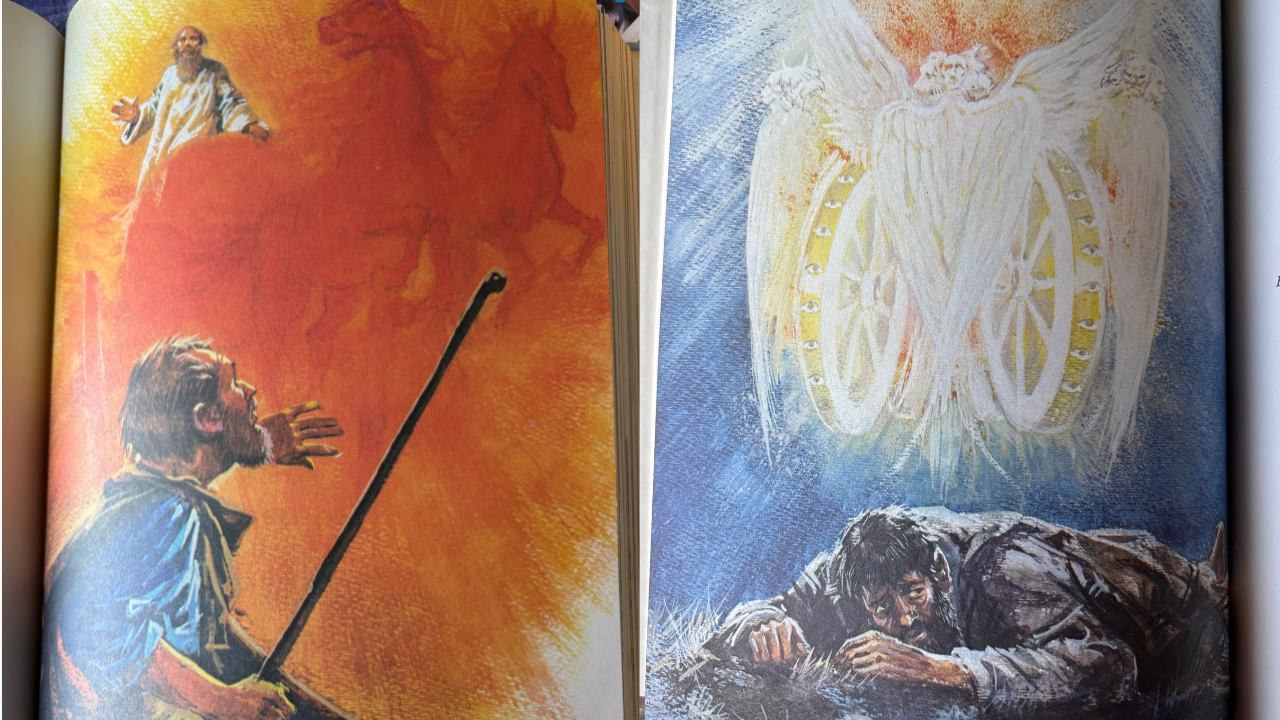
The second scene is the appearance of the Merkavah, the Divine chariot-throne to Ezekiel by the River Chebar (Ezekiel 1). Ezekiel has fallen down at the bottom of the page on the grass and stones, barely able to raise his eyes to the manifestation above him: on a background of deep blue, a bright white, complex figure of wings and wheels, with different faces at the head and ethereal flames rising from the center, illumines Ezekiel's back.
Both of these are images of glory. The first of the glorification of Elijah, the second of Ezekiel's coming face to face with the glory of God, the Kavod Adonai. Later Jewish mystical and Rabbinic speculation will name this glory of God present in the world the Shekinah. I was fascinated by these stories, by stories of God's glory breaking into the mundane, cracking open our day-to-day expectations, bursting our assumptions and certainties. It's no wonder that I have devoted much of my scholarly career to the book of Revelation and other related writings that ponder the glory of God. No wonder I was attracted to the theology of Hans Urs von Balthasar, whose work on theological aesthetics, on the beauty that undergirds all that is, is entitled Herrlichkeit, or in English, The Glory of the Lord. Balthasar aligned Glory and Beauty. At its heart, what we call beauty is a sacrament of the Glory of God.
Fyodor Dostoevsky tried to write about beauty. The tragic protagonist of his novel The Idiot, Prince Myshkin, is something like Dostoevsky's attempt to write a perfectly beautiful human being, a Christ, in flesh and human psyche, as it were. Myshkin fits uncomfortably with the socialites into whose company he has been thrust. His simplicity unnerves and bewilders them. It is one such socialite, Ippolit, who utters one of the better known phrases of Dostoevsky's writings: "'Is it true, Prince, that you once said "beauty" would save the world? Gentlemen,' he cried loudly to them all, 'the prince insists that beauty will save the world!'" Beauty will save the world. Or rather, Glory will save the world.
But where do we find glory? It is tempting to find glory in what knocks us on our faces, blinds us with its overwhelming and extraordinary shine. It is tempting to identify glory with raw power, with strength, even peace through strength. It is tempting to align glory with extreme happiness and delight, emotional elation and dopamine overload. It is tempting to displace God by such glory. But these are temptations, because although God's glory does indeed burst out of the heavens in these two stories, in both they are shrouded in the cloud of the invisible, in mystery and wonder. And they are temptations because the Younger Testament draws out another theme, another site of God's glory.
The early Christians and writers of the New Testament latched onto the song of the Suffering Servant from Isaiah 53:
Who has believed what we have heard?
And to whom has the arm of the Lord been revealed?
For he grew up before him like a young plant
and like a root out of dry ground;
he had no form or majesty that we should look at him,
nothing in his appearance that we should desire him.
He was despised and rejected by others;
a man of suffering and acquainted with infirmity,
and as one from whom others hide their faces
he was despised, and we held him of no account.
Matthew 8:17 quotes Isaiah 53:4: "He took our infirmities and bore our diseases." 1 Peter 2:24 uses Isaiah 53:5 to interpret Jesus on the cross: "He himself bore or sins in his body on the cross, so that, having died to sins, we might live for righteousness; by his wounds you have been healed."
There would appear to be no glory in the figure of Christ on the cross. Christ on the cross would seem to be the opposite of glory: "he had no form or majesty that we should look at him."
In John 12, Jesus is in the middle of praying, and he says: “Now my soul is troubled. And what should I say: ‘Father, save me from this hour’? No, it is for this reason that I have come to this hour. Father, glorify your name.” John continues: "Then a voice came from heaven, 'I have glorified it, and I will glorify it again.' The crowd standing there heard it and said that it was thunder. Others said, 'An angel has spoken to him.' Jesus answered, 'This voice has come for your sake, not for mine. Now is the judgment of this world; now the ruler of this world will be driven out. And I, when I am lifted up from the earth, will draw all people to myself.' He said this to indicate the kind of death he was to die."
In the Gospel according to Mark (10:35-40) James and John make a request of Jesus: “Teacher, we want you to do for us whatever we ask of you.” Jesus asks what they want him to do, and they ask “Appoint us to sit, one at your right hand and one at your left, in your glory.” Jesus tells them they don't know what they are asking: "to sit at my right hand or at my left is not mine to appoint, but it is for those for whom it has been prepared.” As it turns out, in Mark 15:27 we discover for whom it has been prepared: "It was nine o’clock in the morning when they crucified him. The inscription of the charge against him read, 'The King of the Jews.' And with him they crucified two rebels, one on his right and one on his left." Jesus, in his glory, is Jesus on the Cross.
This is one of the upheavals of Christianity--God's glory does not reside simply in the blinding light of splendor, but powerfully in the ugliness of the cross. The great Swiss theologian Karl Barth put it this way: "If we seek Christ's beauty in a glory which is not that of the Crucified, we are doomed to seek in vain. ...In this self-revelation, God's beauty embraces death as well as life, fear as well as joy, what we call 'ugly' as well as what we call 'beautiful.'" As Balthasar says,
Our task...consists in coming, with John, to see his 'formlessness' as a mode of his glory because of mode of his love to the end, to discover in his deformity (Ungestalt) the mystery of transcendental form (Ubergestalt). His bearing of the world's sin (John 1:29), his being made sin for us (2 Corinthians 5:21) is understandable only as a function of the glory of love, before and after and therefore, also during his descent into darkness: what we have before us is pure glory, and even though it is really a concealment and really an entering into darkness.
When Dostoevsky raised the idea that beauty would save the world, he was deeply influenced by an experience he had in 1867 of viewing Hans Holbein's "The Body of the Dead Christ in the Tomb."

Dostoevsky was fascinated by this painting. This was the beauty that Dostoevsky thought would save the world, the beauty of the "idiot" Prince Myshkin, the beauty of Christ in the tomb, the beauty of God's love for us in the depths of our experience. This, Dostoevsky thought, is glory.
This Sunday is Palm Sunday, the beginning of Holy Week, the climax of which is Crucifixion of Jesus. The death of Jesus--if we may so speak, the death of God in the death of Jesus--is a great mystery, and Palm Sunday ends by meditating on the Cross. The mystery is that God's glory breaks out of the ugliness of this death, of this execution. The mystery is that here is glory, because here is the intensity, the gravity, the overwhelming weight of God's love for the world. The Cross, like this painting, shows us that "he had no form or majesty that we should look at him, nothing in his appearance that we should desire him." And yet, it is precisely in the ugliness of this One's death that glory shines on us, that we are made beautiful. As the hymn says, "My song is love unknown, my Savior's love for me--love to the loveless shown that they may lovely be. But who am I, that for my sake, my Lord should take frail flesh and die."
As we approach Holy Week, may you find in the midst of the ugliness of the world the immensity of God's love, may you find in the Crucified One the glory of God.