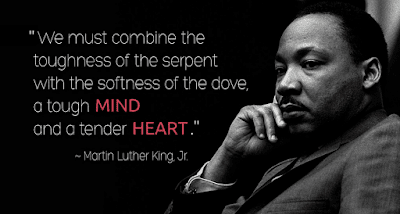
A Tough Mind and a Tender Heart

Andrew Guffey • January 23, 2026

Sheep in the Midst of Wolves

There are a pair of commemorations that fall a week apart in January: The Confession of Peter (January 18) and The Conversion of Paul (January 25). The book of Acts narrates the early life of the church first with Peter as the central apostolic figure, and then with Paul taking the reins. The apostles were those who were sent with a charge to proclaim the good news of God's kingdom, until Christ comes again. Peter takes up the mantle, in one way of understanding it, when he confesses Christ to be the Anointed One (see Matthew 16:13-19).


I will be talking a bit more about the Conversion of Paul on Sunday. But as I was looking ahead, I noticed the Gospel lesson for the commemoration is from Matthew 10:16-22:


Jesus said to the twelve, "See, I am sending you out like sheep into the midst of wolves; so be wise as serpents and innocent as doves. Beware of them, for they will hand you over to councils and flog you in their synagogues; and you will be dragged before governors and kings because of me, as a testimony to them and the Gentiles. When they hand you over, do not worry about how you are to speak or what you are to say; for what you are to say will be given to you at that time; for it is not you who speak, but the Spirit of your Father speaking through you. Brother will betray brother to death, and a father his child, and children will rise against parents and have them put to death; and you will be hated by all because of my name. But the one who endures to the end will be saved."


The warning for Paul, and for the Twelve, is an important caution for us, too, as we go about following where Christ calls us: "See, I am sending you out like sheep into the midst of wolves, so be wise as serpents and innocent as doves."


Fittingly, I thought of Martin Luther King, Jr., whose holiday was Monday. Dr. King gave a sermon that is found in the little volume Strength to Love. He titled it "A Tough Mind and a Tender Heart," basing his message on the need to be wise as serpents (tough-minded) and innocent as doves (tender-hearted). In invite you to read the whole sermon, which you can find here (I don't know the blog well, so I don't necessarily endorse it, but it was the only place I could find it in its entirety online).


Dr. King's point was that to resist evil, to work for justice and peace (all of which we own in our baptismal covenant), we must be neither soft-minded nor hard-hearted. It's a message that we need to hear today, too, because injustice continues to plague us. Here's an excerpt you might find helpful today:


A third way is open to our quest for freedom, namely nonviolent resistance, which combines tough mindedness and tenderheartedness and avoids the complacency and do-nothingness of the soft minded and the violence and bitterness of the hardhearted. ... Through nonviolent resistance we shall be able to oppose the unjust system and at the same time love the perpetrators of the system. We must work passionately and unrelentingly for full stature as citizens, but may it never be said, my friends, that to gain it we used the inferior methods of falsehood, malice, hate, and violence.


I am thankful that we worship a God who is both tough minded and tenderhearted. ... God is neither hardhearted nor soft minded. He is tough minded enough to transcend the world; he is tenderhearted enough to live in it. He does not leave us alone in our agonies and struggles. He seeks us in dark places and suffers with us and for us in our tragic prodigality.


At times we need to know that the Lord is a God of justice. When slumbering giants of injustice emerge in the Earth, we need to know that there is a God of power who can cut them down like the grass and leave them withering like the Greek herb. When our most tireless efforts fail to stop the surging sweep of oppression, we need to know that in this universe is a God whose matchless strength is a fit contrast to the sordid weakness of man. But there are also times when we need to know that God possesses love and mercy. When we are staggered by the chilly winds of adversity and battered by the raging storms of disappointment and when through our folly and sin we stray into some destructive far country and are frustrated because of a strange feeling of homesickness, we need to know that there is Someone who loves us, cares for us, understands us, and will give us another chance. When days grow dark and nights grow dreary, we can be thankful that our God combines in his nature a creative synthesis of love and justice that will lead us through life’s dark valleys and into sunlit pathways of hope and fulfillment.


Like the God we serve, like Christ, may we also be tough-minded enough to transcend the world, and tenderhearted enough to live in it.

By Andrew Guffey March 26, 2026
This Sunday, all are welcome to join us for a morning of worship and fellowship. Whether you are with us in the sanctuary or joining from afar, your presence strengthens our community. Our service is at 9:30 a.m. We warmly welcome those who cannot attend in person to join us via our live stream.
By Andrew Guffey March 21, 2026
This Sunday, all are welcome to join us for a morning of worship and fellowship. Whether you are with us in the sanctuary or joining from afar, your presence strengthens our community. Our service is at 9:30 a.m. We warmly welcome those who cannot attend in person to join us via our live stream.
By Andrew Guffey March 20, 2026
Exercising patience.
By Andrew Guffey March 13, 2026
How do we talk about our Jewish neighbors? 
By Peter Trumbore March 9, 2026
We turned our clocks ahead this past weekend, bringing with it the unwelcome loss of an hour's sleep, time we won't get back again until the fall when we'll reset our clocks all over again. I don't know about you, but for me the extra daylight after the dinner hour doesn't compensate for the misery of waking up in pitch blackness as if we were still in the deepest depths of winter. The twice-yearly ritual of resetting our clocks from standard time to daylight savings time and back again is a reminder that time is fleeting, or as the Roman poet and author Virgil put it, Tempus Fugit , literally time flies. Virgil's original version of this now common phrase emphasized the idea that time irretrievably escapes us. When it's gone, it's gone. This is very different than the line uttered by Matthew McConaughey's character Rust Cohle in the first season of HBO's series True Detective: "Tine is a flat circle." If you're like me, you may have wondered where that phrase came from, and what it means. But thanks to the miracle of modern Internet sleuthing , we've got an answer. It's a reference to German philosopher Friedrich Nietzsche's concept of "eternal recurrence," In short, the idea that because time is endless, everything will eventually repeat itself. That includes your own life, which you will relive in exactly the same way, an infinite number of times, for all eternity. This may sound like a nightmare to you, but Nietzsche saw it as a cause for celebration, assuming you made your life into something you'd want to repeat an infinitely. What this is all getting at is the topic we're going to talk about in our conversation this week -- our perception of and relationship with time. And we'll start simply, with daylight savings time, and dig deeper from there. Which do you subscribe to more, Virgil's idea of time as irretrievably escaping, or Rust Cohle's short-hand Nietzsche of time as eternally recurring? If you had one more hour in your day, 25 rather than 24, how would you use that extra time? What if you knew you could have one more day, or week, or month, or year of life than what you were expecting? What would you do with that? Would you live that bonus time any differently than your everyday? Come spend some quality time with us this Tuesday, March 10, and join the conversation. Discussion starts tomorrow evening at 7pm at Irish Tavern in downtown Lake Orion.
By Andrew Guffey March 8, 2026
This Sunday, all are welcome to join us for a morning of worship and fellowship. Whether you are with us in the sanctuary or joining from afar, your presence strengthens our community. Our service is at 9:30 a.m. We warmly welcome those who cannot attend in person to join us via our live stream.
By Andrew Guffey March 6, 2026
What do we do when we don't know what to do?
By Andrew Guffey March 1, 2026
This Sunday, all are welcome to join us for a morning of worship and fellowship. Whether you are with us in the sanctuary or joining from afar, your presence strengthens our community. Our service is at 9:30 a.m. We warmly welcome those who cannot attend in person to join us via our live stream.
By Andrew Guffey February 27, 2026
Reflecting on Seven Years
By Peter Trumbore February 23, 2026
We're building our conversation this week around the above quote, that has widely been attributed to English modernist writer and feminist pioneer Virginia Woolf. Before you ask, yes, we are aware that some of Woolf's views, especially on race and class, would make her persona non grata in certain circles today. But that said, the quote is worth thinking about. In some ways it is reminiscent of a quote from C.S. Lewis that was the focus of one of our conversations some eight years ago. Lewis said: "When I became a man I put away childish things, including the fear of childishness and the desire to be very grown up." What both writers seem to be pointing to is the obvious truth that as we age we grow and change. Including our views, our ideas of how the world works, our preconceived notions of ourselves and others. And sometimes that change will feel like loss. What takes the place of those things we've lost? For Woolf, it's other illusions. This brings us back to Woolf's quote. What do you think she is getting at here? Are there illusions that you've had to lose as you've grown older and (hopefully) wiser? What might those be for you? And what about the other half of the quote? What kind of new illusions have we acquired as we've shed others? Finally, are there "comforting illusions" that you still cling to? And to make it a little provocative, is your faith one of them? Come help us sort it all out tomorrow evening. Join us for the discussion Tuesday, Feb. 24 starting at 7pm at Irish Tavern in downtown Lake Orion.