Weapons of Poverty and Prayer
Haunted by Dorothy Day.
In her diary entry from February 11, 1969, Dorothy Day quotes a line from one of Dostoevsky's novels. In The Possessed [or, Devils], the character Kiriloff says, "All my life I have been haunted by God." Day seems to take it as an apt description of her own life. But we might amend it somewhat: Day was haunted by God on behalf of the poor.
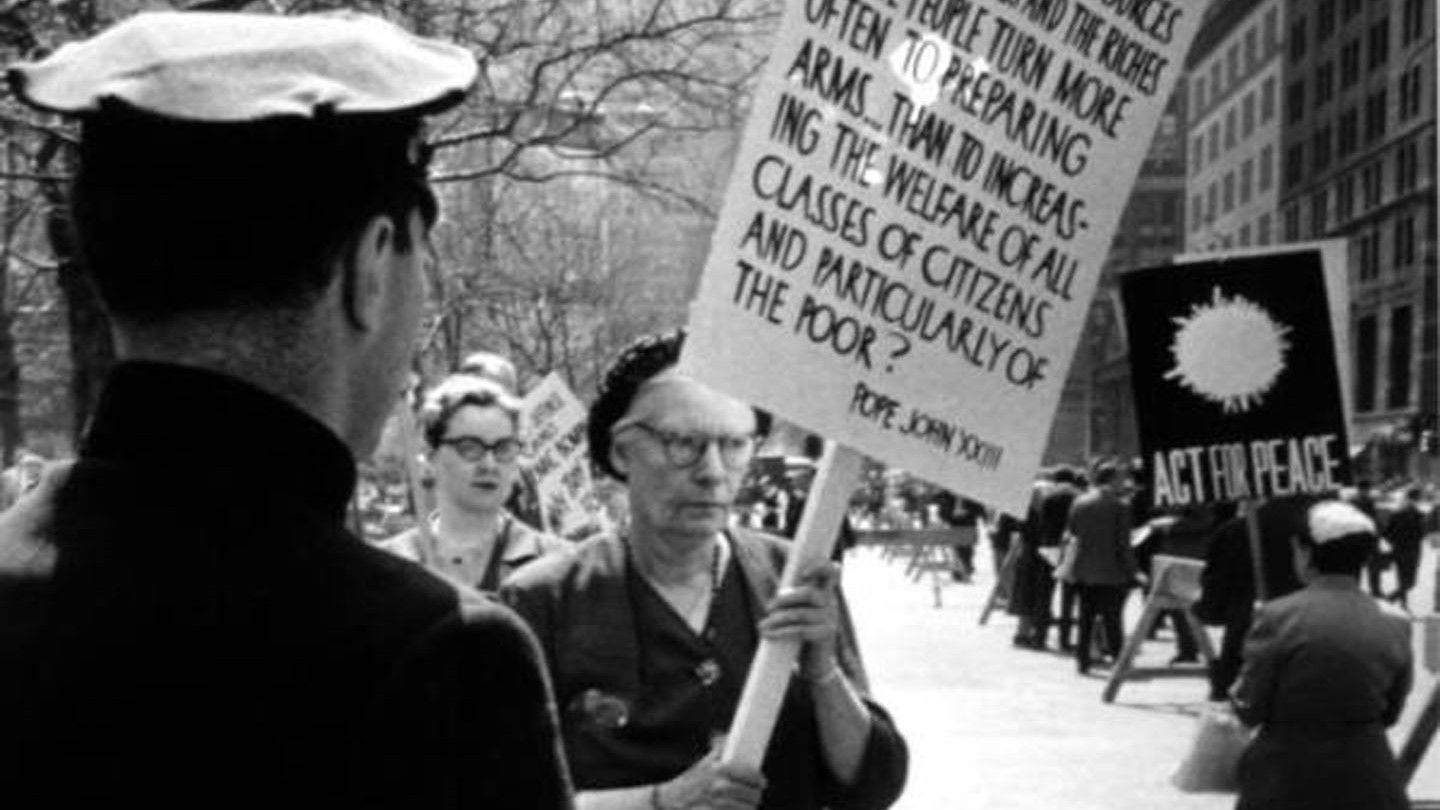
For my part, I am haunted by Dorothy Day. Or, at least, I'm haunted by her hauntedness: the earnestness of her life, and the radical values of the Gospel she embodied. By the time she was writing in her diary in 1969, Day had co-founded the Catholic Worker movement and dedicated her life to the Scriptures, the Sacraments, works of mercy, and solidarity with the poor. Dorothy Day devoted her life to living among the poor, as the poor, with the poor. And she did so because she was haunted by God. She once wrote, "Without [our own] poverty we will not have learned love, and love, at the end, is the measure by which we will be judged."
It sounds radical. And it is. But she's not actually being all that original. As I write this I am finishing up final grading for the course I taught this semester on the Rise of Christianity. I've been teaching this course for years, and every year I find the teaching of the early Christians about wealth to be challenging...and haunting. My students don't always seem to grasp the radical nature of what is being said when, for instance, Basil of Caesarea, the great fourth-century bishop and theologian, says, "Nothing withstands the influence of wealth. Everything submits to its tyranny, everything cowers at its dominion." This is just one small line in a scalding, gob-smacking, mic-dropping, banger of a sermon, "To The Rich." Basil's sermon revolves around Jesus's prescription for the young man who came to him, eager to be about God's work in the world. Jesus says to the young man, "If you will be perfect, go, sell what you possess, give to the poor, and you will have treasure in heaven; then, come and follow me" (Matthew 19:21). Basil pulls as many punches as Jesus--none whatsoever. Seriously, go read it; it's spicy.
Basil must have been haunted by God, too. The story of they rich young man was his story. He grew up in a wealthy family. And while he utilized that wealth for an advanced education, he also came to the same point in his life that Dorothy Day did--he sold off family estates to give the poor and converted one such estate to serve the poor--as the fourth-century equivalent of a soup kitchen, food pantry, shelter, and clinic.
But Basil and Day are not the only ones in the history of Christianity to be haunted by God on behalf of the poor. A number of my students also miss this question: True or False: Early Christians routinely taught that the wealthy should divest themselves of their wealth and give it to the poor. Probably at least half of my students read that on the final exam, and no matter how much we've covered it, it almost seems to strike them for the first time just how radical the "traditional" Christian position was, and they think they couldn't possibly have been teaching that, so they circle False. But it's remarkably true.
It could be a long list. Let's just skip over Jesus, who constantly warned against riches and constantly advocated for the poor. And we'll skip over the Acts of the Apostles, where the Christians hold all things in common. But then late in the first or early in the second century, an influential writing that is known as the Didache or "Teaching" of the Twelve Apostles, says this: “Share everything with your brother. Do not say, ‘It is private property.’ If you share what is everlasting, you should be that much more willing to share things which do not last.” Likewise, Justin Martyr, an influential Christian philosopher and theologian of the second century says, "We who once took most pleasure in the means of increasing our wealth and property now bring what we have into a common fund and share with everyone in need.” The purpose of holding all things in common, a habit that seems to have outlasted the apostles, was for the benefit of the needy.
Irenaeus, Bishop of Lyons in the late second century confirms this Christian expectation: “And instead of the tithes which the law commanded, the Lord said to divide everything we have with the poor. And he said to love not only our neighbors but also our enemies, and to be givers and sharers not only with the good but also to be liberal givers toward those who take away our possessions.” Irenaeus says that sharing with the poor, our own poverty, and our love, not only for our neighbors but also for our enemies--these are what it really means to live Christianly in the world.
Already, we've traveled from Judea to Syria to Rome to Gaul (current-day France). But the expectation that Christians would be on the side of the poor and against the hording of wealth was widespread and persisted. In third-century Egypt a young wealthy man named Antony became the pioneer of Christian monasticism, and he would influence other major thinkers and bishops like Athanasius of Alexandria and Basil. When Antony came into his inheritance at a young age, he was troubled when he heard the Gospel of the rich young man in church. He took the words to heart, sold all his possessions, gave it to the poor, handed over the guardianship of his sister to a community of Christians in Alexandria, and then abandoned a life of comfort to find God in poverty and need. In North Africa at the beginning of the fourth century, Cyprian of Carthage said: "The property of the wealthy holds them in chains . . . which shackle their courage and choke their faith and hamper their judgment and throttle their souls. They think of themselves as owners, whereas it is they rather who are owned: enslaved as they are to their own property, they are not the masters of their money but its slaves.” And it was a recurring theme also with John Chrysostom, Archbishop of Constantinople in the late fourth century: “The rich are in possession of the goods of the poor, even if they have acquired them honestly or inherited them legally." “Not to enable the poor to share in our goods is to steal from them and deprive them of life. The goods we possess are not ours but theirs.”
This is what haunts me. It's what haunted Basil, and Antony and Justin and Irenaeus and Cyprian and Chrysostom. It's what haunted Dorothy Day. The story of the young man ends with him going away grieving, because he had many possessions. I worry that I am the young man, and that I have not yet learned how to be poor toward the world but rich toward God.
As I was thinking about all of this, I picked up the little book of excerpts from Dorothy Day published by Plough Publishers, The Reckless Way of Love (ed. Carolyn Kurz). In chapter 12, the editor cleverly puts together two excerpts:
"Men and women have persisted in their hope for happiness. They have hoped against hope though all the evidence seemed to point to the fact that human nature could not be changed. Always they have tried to recover the lost Eden, and the history of our own country shows attempts to found communities where people could live together in that happiness which God seemed to have planned for us. ...Saint Teresa said that you can only show your love for God by your love for your neighbor, for your brother and sister. Francois Mauriac, the novelist, and Jacques Maritain, the philosopher, said that when you were working for truth and justice you were working for Christ, even though you denied him. But how to love? That is the question."
Happiness depends on our ability to love our neighbor, and loving our neighbor entails working for truth and justice. But how to love? Carolyn Kurz has edited this question together with a beautiful selection:
"The solution proposed in the Gospels is that of voluntary poverty and the works of mercy. It is the little way. It is within the power of all. Everybody can begin here and now. ...We have the greatest weapons in the world, greater than any hydrogen or atom bomb, and they are the weapons of poverty and prayer, fasting and alms, the reckless spending of ourselves in God's service and for his poor." That's when Day finishes with the line I quoted earlier: "Without poverty we will not have learned love, and love, at the end, is the measure by which we shall be judged."
If poverty and solidarity with the poor are the measure by which we shall be judged, then I am worried that I am not measuring up. Of course I am aware that I am not among the very wealthy, but am I really among the poor? Am I the young man walking away from Jesus, or am I willing to follow where Jesus calls? That's why Dorothy Day haunts me. I don't have an answer to that. I do trust that God will accept whatever gifts I give, whatever sacrifices I make for his people, and especially for the poor. But Dorothy Day and the great cloud of witnesses of which she is a part haunt me, ensure that I am never too comfortable with my possessions and always looking for how to be of benefit for all who are in need, how to live in solidarity with the poor.
Day says that our weapons are stronger than those that destroy--our weapons are those of poverty and prayer, fasting and alms, and the reckless spending of ourselves in God's service and for his poor. Love is our weapon. Love is the secret of God's glory and of a good life. And love makes demands. But woe to me if I stop listening to love's demands. Woe to me if I ever grow too comfortable in my life while others live in want and hunger. Woe to me if I forget that my life is bound up with the life of my brothers, sisters, siblings living in poverty and need.
I'm haunted by Dorothy Day. And I'm glad I am.