
Pub Theology 2/18/25 -- Is common sense enough?
Peter Trumbore • February 17, 2025

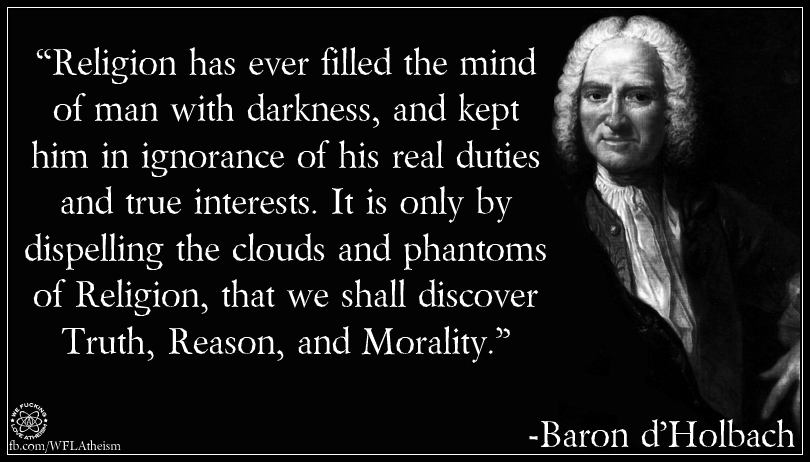
Indifference, if not outright hostility, toward religion is not just a feature of our current age, but has been around for quite a while. Humanists, secular philosophers, and atheists of many stripes have long tarred religion with the brush of superstition and ignorance. The quote above, from 18th century French Enlightenment philosopher and writer Paul Thiry Baron d'Holbach, comes out this tradition.


D'Holbach believed that people can use common sense to discover moral principles without needing religion or divine intervention. He thought that people should be just, moderate, and sociable because it makes them feel good, not because it's what a god commands. In his 1772 book Good Sense: or, Natural Ideas Opposed to Supernatural makes the following claim: "To discover the true principles of Morality, men have no need of theology, of revelation, or of gods: They have need only of common sense.”


At its heart, what d'Holbach puts forward is an alternative theory of the origins of morality. As an advocate of secular morality, and a self-described anti-theist and opponent or religion, d'Holbach and others who have adopted this perspective essentially argue that morality doesn't require religion. It's based on social ties, education, and sympathy. Some say that people shouldn't be motivated by the fear of punishment or the hope of reward after death. In contrast, those who approach morality through a theist lens, i.e. a belief in God (or gods), suggest that without God, morality would just be a social convention without any universal validity beyond cultures or self-interest.


The second chapter of the Epistle to Titus, traditionally attributed to St. Paul though the scholarly consensus casts significant doubt on that attribution today, is essentially guidance to clergy, specifically bishops, for the teaching of "sound doctrine," in other words instruction in what does and does not meet the demands of moral conduct. Titus 2:11-12 roots this in the divine: "For the grace of God has appeared for the salvation of all men, training us to renounce irreligion and worldly passions, and to live sober, upright, and godly lives in this world,"


Let's talk about this. Is common sense, and common sense alone, sufficient to produce morality, or, as the baron puts it, discover its true principles? Is d'Holbach right, is common sense enough? And if it is, why does it -- both common sense and morality -- seem is such short supply sometimes? Or is morality a consequence of divine authority?


Join us for the conversation this week as we wrestle with the age-old question of where morality comes from. The discussion starts at 7pm Tuesday, Feb. 18 at Casa Real in downtown Oxford.

By Peter Trumbore December 2, 2025
"Only when I understood that I had a primal need for silence was I able to begin my search for it – and there, deep beneath a cacophony of traffic noise and thoughts, music and machinery, iPhones and snow ploughs, it lay in wait for me. Silence." -- So writes Norwegian explorer Erling Kagge. In tonight's discussion we're going to talk about the role of silence in our everyday and spiritual lives. For one window into this, consider the practice of Quaker Meeting, in which worship takes place in collective silence. As Tracy Chevalier writes in The Guardian : "Since their establishment in the mid-17th century, Quakers – or the Society of Friends, as they are formally known – have worshipped in collective silence, without the intervention of priest or minister, listening in the stillness for something non-verbal and timeless tucked deep inside. Some call it God, or the Spirit, or the Inner Light, or something less overtly religious. By stripping away noise, it is easier to let go of the everyday, settle one's thoughts, and listen. Quaker Meeting is much like meditation, except done together. The communal nature of the experience is essential, for being with others makes the silence more valuable. Sometimes at Meeting when I'm restless, I sense the stillness of those around me and it reminds me of what I'm doing, so that I sit still and try again." In his book, "Silence, in the Age of Noise," Kagge asks, and then seeks the answers to three basic questions: "What is silence? Where is it? Why is it more important now than ever?" We will look for our own answers in our conversation beginning at 7 pm this evening at Irish Tavern in downtown Lake Orion. Check out the link below to read an excerpt from Kagge's book. https://www.theguardian.com/lifeandstyle/2017/sep/23/the-power-of-silence-in-the-smartphone-age?fbclid=IwY2xjawObzTNleHRuA2FlbQIxMABicmlkETFObmh6OEdIZGJjUklzR0dEc3J0YwZhcHBfaWQQMjIyMDM5MTc4ODIwMDg5MgABHocsRhIVswsmRIzbW5YQMFbtEEaZX0DCx_8wGMMljDE0ojk0MuzgCHlR63M9_aem_Ea0AQyoEEfNf5o7ebu_OPg
By Andrew Guffey November 30, 2025
This Sunday, all are welcome to join us for a morning of worship and fellowship. Whether you are with us in the sanctuary or joining from afar, your presence strengthens our community. Our service is at 9:30 a.m. We warmly welcome those who cannot attend in person to join us via our live stream.
By Andrew Guffey November 23, 2025
This Sunday, all are welcome to join us for a morning of worship and fellowship. Whether you are with us in the sanctuary or joining from afar, your presence strengthens our community. Our service is at 9:30 a.m. We warmly welcome those who cannot attend in person to join us via our live stream.
By Peter Trumbore November 17, 2025
Artificial intelligence (AI for the uninitiated) seems to be worming its way into more and more aspects of our daily lives. Or at least AI hype seems to be. In high schools and colleges we have students using AI to do their homework, in the working world job-seekers are using AI to write and submit job applications while businesses use AI to read and evaluate those applications. Folks are using AI to plan their vacation itineraries, set fitness goals and create workout plans, write recipes, give them relationship advice, to take the place of therapists, and even as stand-ins for real world friends, confidants, or romantic partners. And now it's come for our churches. Some years back in one of our pre-pandemic conversations, we talked about the role of technology in our faith lives, but at that time the most exotic application we had run across was a "virtual reality Jesus experience" that purported to let users walk alongside Jesus and the disciples through the Gospel narrative. That sounded pretty lame to all of us, including our resident VR enthusiast at the time. Let's just say the technology has ... moved forward ... since then. Where VR Jesus offered a chance to walk with Jesus, new AI-based apps will let you talk with the Son of God, or at least a chatbot version of the Savior. The Text with Jesus app lets users ask questions of and converse with not just Jesus, but other biblical figures, from apostles to prophets. Apparently the premium version will unlock the ability to chat with Satan too. Other AI-powered faith resources are out there too, including EpiscoBot , created for The Episcopal Church by TryTank, a research institute associated with the church's Virginia Theological Seminary. This draws on church resources and teaching to respond to faith-based and spiritual queries. For Roman Catholics, apps like One Day Confession and Confession -- Catholic (you can find them in the Apple App Store) help the faithful confession and spiritual reflection. And a California megachurch pastor has created an AI chatbot version of himself to provide one-on-one spiritual guidance, all for the low, low cost of $49 a month. We're not providing a link to that one. What to make of all this? That's the topic of our conversation this week. To help you think about the issues, here's a link to an article just published in the UK-based web magazine UnHerd, written by a friend of mine, a priest in the Church of England. In it the Rev. Gerry Lynch writes that despite the perils and pitfalls, "Some churches will nonetheless become tempted by the AI hype. They should heed the lessons learnt during the pandemic, when online services and “virtual church” were presented as a God-sent means of Christian revival instead of a regrettable necessity in extreme circumstances." And here's another story on one experiment in having an AI Jesus hear confession at a Roman Catholic Church in Switzerland. Join us for the discussion this Tuesday evening, Nov. 18, starting at 7pm at Irish Tavern in downtown Lake Orion. Word on the street has it that we may even reach out directly, or via text at least, with Jesus himself and see what the Redeemer of Mankind has to say.
By Andrew Guffey November 16, 2025
This Sunday, all are welcome to join us for a morning of worship and fellowship. Whether you are with us in the sanctuary or joining from afar, your presence strengthens our community. Our service is at 9:30 a.m. We warmly welcome those who cannot attend in person to join us via our live stream.
By Peter Trumbore November 11, 2025
Our usual conversation got a little sidetracked last week as our discussion leader was traveling due to a family commitment. But that means we've got some tasty leftovers that we can chew on this week! If you recall, last week we're going to talk a little about the Beatitudes, as recounted in the Gospel of Luke. Take a look at last week's topic for the precise passage, but the principal question we were going to address was this: If the words of Jesus about loving your enemies and so on are central to what it means to be a Christian, how well do we measure up? Time permitting, once we've wrestled with this, we've got a couple of other questions to which we can turn, one scripturally based, the other philosophical.  In Matthew's Gospel (6:34), Jesus has some words that seem pretty relevant in these anxiety-filled days: "So do not worry about tomorrow, for tomorrow will bring worries of its own. Today’s trouble is enough for today." Is this good advice? Or even realistic to ask? What do you think is Jesus' basis for saying this? Finally, is not having to worry something that only privileged people can practice? And now, to throw a little philosophy into the mix, the French philosopher Rene Descartes (no horse jokes please) said this: "We do not describe the world we see. We see the world we can describe." What do you think he is getting at here, and do you agree? Join us for the conversation this evening, Tuesday Nov. 11, starting at 7pm at Irish Tavern in downtown Lake Orion.
By Andrew Guffey November 9, 2025
This Sunday, all are welcome to join us for a morning of worship and fellowship. Whether you are with us in the sanctuary or joining from afar, your presence strengthens our community. Our services are at 8:30 and 10:00 a.m. We warmly welcome those who cannot attend in person to join us via our live stream.
By Peter Trumbore November 3, 2025
This past Sunday at St. Mary's we celebrated the feasts of All Saints and All Souls. It was an opportunity for us to remember and pray for those who have gone on before, and to think about their witness and the witness of all the saints, whether officially designated by The Church or not. It was a beautiful service in which we welcomed new members of the congregation, experienced the joy of a baptism, and lit candles for those departed who were near and dear. But that's not what we're here to talk about this week. The service also featured a famous bit of scripture that gives us a lot to think about. And to wonder whether we're up to the task. Our Gospel reading was from Luke 6:20-31, the version of the beatitudes, or blessings, taken from Jesus Sermon on the Plain. (Matthew's version, 5:3-10, comes from the Sermon on the Mount.) In this sermon, Jesus lays out four blessings and four woes, but it's the last part that is a particularly challenging call to action. Jesus lays this charge before his apostles and the gathered crowd: "But I say to you that listen, Love your enemies, do good to those who hate you, bless those who curse you, pray for those who abuse you. If anyone strikes you on the cheek, offer the other also; and from anyone who takes away your coat do not withhold even your shirt. Give to everyone who begs from you; and if anyone takes away your goods, do not ask for them again. Do to others as you would have them do to you." This is some pretty powerful food for thought, and so we are going to spend some time thinking about and talking about this in our conversation this week. Rather than a series of questions, let's just go with this. If these words of Jesus are central to what it means to be a Christian, how well do we measure up? Join us for the conversation this Tuesday, Nov. 4, starting at 7pm at Irish Tavern in downtown Lake Orion.
By Andrew Guffey November 2, 2025
This Sunday, all are welcome to join us for a morning of worship and fellowship. Whether you are with us in the sanctuary or joining from afar, your presence strengthens our community. Our services are at 8:30 and 10:00 a.m. We warmly welcome those who cannot attend in person to join us via our live stream.
By Andrew Guffey October 26, 2025
This Sunday, all are welcome to join us for a morning of worship and fellowship. Whether you are with us in the sanctuary or joining from afar, your presence strengthens our community. Our services are at 8:30 and 10:00 a.m. We warmly welcome those who cannot attend in person to join us via our live stream.