Pub Theology 4/23/24 — Just one word …

Pete Trumbore • April 22, 2024

April is considered Earth Month, and Monday, April 22, was Earth Day. So it seems fitting that we should devote our conversation this week to questions of our relationship with the earth and how we care for, or don’t, God’s creation.

The classic line from the film, “The Graduate,” referenced above, is a great launching point for this topic. Plastic was first created in 1907, but production on a global scale only began in the 1960s. What was initially touted as a miracle invention has in the last 70 or so years become a global scourge. According to some estimates, the world produces around 400 million metric tons of plastic waste each year. Every day, 2,000 truckloads of it is dumped into the ocean, rivers and lakes. And the manufacturing process itself has been identified as a major source of climate-warming greenhouse gas emissions.

To mark Earth Day Sunday, the ecumenical organization Creation Justice Ministries created a resource for congregations titled Plastic Jesus: Real Faith in a Synthetic World. The effort is “designed to help congregations think more deeply about the ways that plastics impact their lives and God’s creation. It is also intended to equip people of faith to take actions to address this epidemic in faithful and practical ways.”

As Creation Justice Ministries points out, plastics, which are ubiquitous to our world, would be completely alien to our foreparents in our faith. “It is a reminder that, as Dr. Ellen Davis has said, we in the present-day western world have more distance from the world of the Bible than any other culture in history. That’s not just in terms of time, but also in terms of technology, attitudes and disconnection from the non-human world around us.”

In Raleigh, North Carolina, the Episcopal Church of the Nativity has developed a ministry called Zero Waste Church , encouraging other churches and congregations to deepen their faith through care for creation. The Rev. Stephanie Allen, rector of Nativity, frames the issue of plastics theologically: “Plastic is a sacrament for our god of convenience.”

Creation Justice Ministries goes further and in the process, poses questions that we will take up in our discussion this week: “Justice for creation requires a rethinking of our relationship to plastics. Is it enough that we recycle and find alternatives to single-use items to reduce the amount of plastic that ends up in landfills? How do we account for the fact that plastics are often produced in historically oppressed communities so that their very production harms the health of Black, Brown and poor White communities? Do we even have the means to remove enough plastic from our rivers, lakes and the ocean to preserve the bioregions made vulnerable by plastic waste?”

To put it another way, what might need to happen for the world to repent from its dependence on plastic?

We’ll talk about plastics, Earth Day, and a whole lot more in our conversation this week, Tuesday, April 24. Join us for the discussion beginning at 7 pm at Casa Real in downtown Oxford.
By Peter Trumbore May 18, 2026
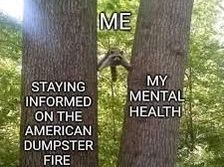
With mid-May upon us, and summer on the doorstep, we are well and truly into spring, typically seen as a season of renewal. A couple of things have brought this to my mind this week. And not just the flowers growing up and around and through the old animal skulls that we artistically left in the chaos garden behind the house when we moved in two springs ago. For context, these used to hang on the wall in the garage at our old house. First, in typical New York Times fashion, their podcast The Daily last week ran a piece on what was claimed to be Americans' "revisiting of religion," and "putting secularism on hold." I listened to the thing, and what it seems to be based on is anecdotal evidence drawn from conversations that the writer of their Belongings newsletter has had with friends, acquaintances, and her family members over the last year or two of her writing the newsletter. Classic New York Times! But still something to contemplate, especially her argument that this turn back to religion is being driven by people's desire for community, connection, and meaning in their lives. Second, and in an echo of our topic of discussion last week, The Washington Post last week ran a piece by a religion professor at the University of North Carolina Wilmington proposing that the government's release of new previously classified material on UFOs was offering support and recognition of a new religion, belief in UFOs. The author writes: "UFO belief is not a religion in the traditional sense. There are no centralized leaders: no popes, no universally recognized doctrines, no sacred text and no institution capable of enforcing orthodoxy. Yet it increasingly performs many of the functions historically attributed to religion. It organizes communities of belief, creates narratives of revelation, offers cosmological meaning and establishes interpretive frameworks through which people understand mysterious experiences and humanity’s place in the universe." A key idea here is that UFO religion is profoundly anti-institutional, built on a foundation of distrust of government, mainstream media, academia, and organized religion. But again, driven by people seeking community, connection, and meaning. Finally, over the weekend there was a White House-sponsored all-day prayer event on the National Mall in Washington D.C. aimed at "rededicating" America as "One Nation under God." Of course it was a decidedly Christian and evangelical version of God that was the focus. Still, thousands showed up and participated. More people looking for and apparently finding some kind of connection, community, and meaning. And a form of renewal at least in the eyes of the organizers and participants in the event. We're going to talk about the idea of renewal in our conversation this week. Are we in a time of spiritual or religious renewal in this country, as the above examples suggest? What would such a thing look like? Would we know it if we saw it? And is it renewal at all, or something different? Join us for the discussion starting at 7pm Tuesday, May 19 at Irish Tavern in downtown Lake Orion.
By Andrew Guffey May 17, 2026
This Sunday, all are welcome to join us for a morning of worship and fellowship. Whether you are with us in the sanctuary or joining from afar, your presence strengthens our community. Our service is at 9:30 a.m. We warmly welcome those who cannot attend in person to join us via our live stream.
By Andrew Guffey May 15, 2026
The Feast of the Ascension 
By Peter Trumbore May 11, 2026
Just last week, the federal government released their latest set of "disclosures" concerning UFOs, or, as the government now calls them, "Unidentified Anomalous Phenomena," (UAPs). Or what we used to call flying saucers and little green men, The collection of photos and reports was met with what could best be described as an underwhelming response. Writing in The Atlantic, astrophysicist Adam Frank put it this way: "Spaceships. That’s all I’m asking for. Just one actual stinking spaceship. I’d also take an actual alien body—I’ve been told that the government has some of them as well. Instead, the first “alien files,” released yesterday, appear to be the same old, same old: stories, but no hard evidence—certainly not of the kind I’d want to see as a scientist, or that could truly advance the debate about UFOs and their alien connection. ... I am disappointed." If you read that like I did, then I suspect you too have echoes of the story of Doubting Thomas ringing in your ears. We hear the story of Thomas right after Easter. It recounts the disciple's unwillingness to accept the fact of the resurrection unless he can see and touch the evidence for himself. Thomas needed to see the marks and put his fingers in the wounds before he'd believe that Christ had risen from the dead. This raises the obvious question of what counts as evidence, whether we're talking about the truth of the existence of UFOs and extraterrestrial intelligence, or any other phenomenon we accept as true without ever having seen or experienced for ourselves. Take earthquakes, for example. I know they exist but I've never seen or felt one in real life. Or Bigfoot. I know Bigfoot is real even though I've never laid eyes on the critter. OK, maybe not Bigfoot. And maybe not the supposed "mummified aliens" that were displayed several years ago on the floor of the Mexican congress. One of them is shown in the photo above. Let's just say that in this case seeing was not necessarily believing, as this report from Reuters attests. The latest set of disclosures on UFOs has also been met with more than a healthy dose of skepticism. The Associated Press reports that the latest releases leave the task of interpreting the meaning of the photos and the reports to the public themselves. For the astrophysicist Frank, that's not good enough: "A real disclosure would look very different, because only one thing matters: hard evidence." So let's talk about this question of evidence in our conversation this week. What would it take for you to believe in the reality of UFOs, or, for that matter, anything else that lives outside the realm of your own personal experience? What counts as evidence for you, whether the question is about UFOs, or Bigfoot, or the resurrection for that matter? Join us for the discussion starting at 7pm. Due to the water main failure's impact on Lake Orion, we will meet this week at Sullivan's Public House in downtown Oxford. Parking is easiest behind the restaurant. We will probably be seated upstairs, so if you don't see us when you arrive, look for us there.
By Andrew Guffey May 9, 2026
This Sunday, all are welcome to join us for a morning of worship and fellowship. Whether you are with us in the sanctuary or joining from afar, your presence strengthens our community. Our service is at 9:30 a.m. We warmly welcome those who cannot attend in person to join us via our live stream.
By Andrew Guffey May 9, 2026
A Primer on the Book of Common Prayer
By Andrew Guffey May 3, 2026
This Sunday, all are welcome to join us for a morning of worship and fellowship. Whether you are with us in the sanctuary or joining from afar, your presence strengthens our community. Our service is at 9:30 a.m. We warmly welcome those who cannot attend in person to join us via our live stream.
May 2, 2026
Haunted by Dorothy Day.
By Peter Trumbore April 28, 2026
OK, before you feel the urge to point it out, I know that this is probably the most misquoted line in cinema history. The words, "play it again, Sam," are never uttered in the the classic 1942 film Casablanca. Instead, Ilsa (played by Ingrid Bergman), says "Play it once, Sam, for old times' sake." Accurate, but not really fit for our purpose this week. What do I mean? Well, we're revisiting a topic that was on our agenda a couple of weeks ago but which, due to some unforeseen circumstances, we didn't actually get to. So we're literally going to play it again. Just after Easter, we were going to talk about one of the episodes that leads up to the climactic events of Holy Week, Jesus flipping the tables of the money changers and merchants and driving them from the Temple. Take a look at the PubTheo entry for April 7 for the full outline of the discussion topic. But suffice it to say, Jesus makes quite a scene, and in the process leaves us with some things we can contemplate. Join us for the conversation this evening, Tuesday April 28, and help us figure out what tables Jesus would flip and who he would drive from the Temple today. The discussion starts at 7pm at Irish Tavern in downtown Lake Orion. 
By Andrew Guffey April 26, 2026
This Sunday, all are welcome to join us for a morning of worship and fellowship. Whether you are with us in the sanctuary or joining from afar, your presence strengthens our community. Our service is at 9:30 a.m. We warmly welcome those who cannot attend in person to join us via our live stream.