Pub Theology 1/14/25 -- Logic, imagination, and what's left to learn
Peter Trumbore • January 13, 2025

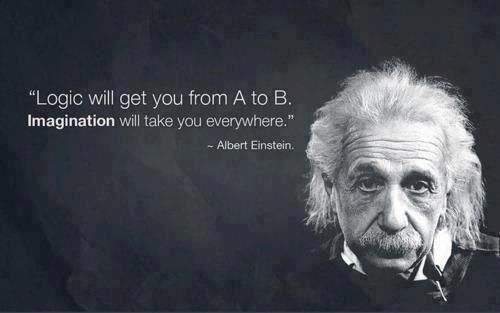
Your hardworking staff here at PubTheo came across the above quote from Albert Einstein the other day, and it sparked a thought: When was the last time I really exercised my imagination? Much of my day-to-day revolves around task management and following the dictates of a fairly  routine schedule. In these circumstances I think I fall back on logic -- Einstein's getting from A to B -- much more so than any real sense of imagination. So when do I exercise my imagination?


Einstein also had this to say about imagination and knowledge: "Imagination is more important than knowledge. Knowledge is limited. Imagination encircles the world." A more famous version of this quote appears in a book Einstein wrote in 1931, Cosmic Religion and Other Opinions and Aphorisms. "At times I feel certain I am right while not knowing the reason. When the eclipse of 1919 confirmed my intuition, I was not in the least surprised. In fact, I would have been astonished had it turned out otherwise. Imagination is more important than knowledge. For knowledge is limited, whereas imagination embraces the entire world, stimulating progress, giving birth to evolution. It is, strictly speaking, a real factor in scientific research.”


What is your take on all of this? What role does imagination play in your everyday life? Or in your life in general? Do you see the distinction between logic and imagination that Einstein identifies? What about the idea that imagination is more important than knowledge? What do you think Einstein was driving at? Do you agree? Which is more important in your  own life, knowledge or imagination?  Would you say that most problems stem from a lack of knowledge, or a lack of imagination?


For a longer discussion of Einstein's perspective on the relationship between knowledge and imagination, this article is worth reading.


Where would you say imagination comes from? Do you consider yourself an imaginative person? Have you ever let your imagination run wild? What was that like for you? Finally, have you ever met anyone that you believed was truly lacking in imagination?


Join us for the conversation this Tuesday evening, Jan. 14, starting at 7pm at Casa Real in downtown Oxford. Imagine what a great discussion we'll have!

By Andrew Guffey March 1, 2026
This Sunday, all are welcome to join us for a morning of worship and fellowship. Whether you are with us in the sanctuary or joining from afar, your presence strengthens our community. Our service is at 9:30 a.m. We warmly welcome those who cannot attend in person to join us via our live stream.
By Andrew Guffey February 27, 2026
Reflecting on Seven Years
By Peter Trumbore February 23, 2026
We're building our conversation this week around the above quote, that has widely been attributed to English modernist writer and feminist pioneer Virginia Woolf. Before you ask, yes, we are aware that some of Woolf's views, especially on race and class, would make her persona non grata in certain circles today. But that said, the quote is worth thinking about. In some ways it is reminiscent of a quote from C.S. Lewis that was the focus of one of our conversations some eight years ago. Lewis said: "When I became a man I put away childish things, including the fear of childishness and the desire to be very grown up." What both writers seem to be pointing to is the obvious truth that as we age we grow and change. Including our views, our ideas of how the world works, our preconceived notions of ourselves and others. And sometimes that change will feel like loss. What takes the place of those things we've lost? For Woolf, it's other illusions. This brings us back to Woolf's quote. What do you think she is getting at here? Are there illusions that you've had to lose as you've grown older and (hopefully) wiser? What might those be for you? And what about the other half of the quote? What kind of new illusions have we acquired as we've shed others? Finally, are there "comforting illusions" that you still cling to? And to make it a little provocative, is your faith one of them? Come help us sort it all out tomorrow evening. Join us for the discussion Tuesday, Feb. 24 starting at 7pm at Irish Tavern in downtown Lake Orion.
By Andrew Guffey February 22, 2026
This Sunday, all are welcome to join us for a morning of worship and fellowship. Whether you are with us in the sanctuary or joining from afar, your presence strengthens our community. Our service is at 9:30 a.m. We warmly welcome those who cannot attend in person to join us via our live stream.
By Andrew Guffey February 20, 2026
This is us.
By Andrew Guffey February 15, 2026
This Sunday, all are welcome to join us for a morning of worship and fellowship. Whether you are with us in the sanctuary or joining from afar, your presence strengthens our community. Our service is at 9:30 a.m. We warmly welcome those who cannot attend in person to join us via our live stream.
By Andrew Guffey February 13, 2026
Rem ember, you are dust.
By Peter Trumbore February 9, 2026
Every now and again we dip into the archives to bring back a topic from a past discussion. When you've been doing this for more than a dozen years, there's plenty of good stuff to revisit. So we're doing that this week, and it turns out to be a surprisingly timely decision. Next Tuesday marks Random Acts of Kindness Day (yes, really), and it turns out that nine years ago, almost to the very day, our conversation revolved around the idea of random acts of kindness. Since we last talked about it, the idea of random acts of kindness has become surprisingly institutionalized. According to the Random Acts of Kindness Foundation , which actively encourages just such things, "When we choose kindness, our brains light up with oxytocin, dopamine, and connection; reminding us that kindness is not just good for the world, it is good for us." And almost 250,000 people worldwide have signed up with the foundation as RAKtivists, pledging to try to make the world a better place one act of kindness at a time. For its part, the foundation, which aims to make kindness a norm, offers kindness tips and suggestions, creates teaching materials, and encourages kindness in our schools, homes, and in our workplaces. For example, when on social media they suggest: "Scroll until you see someone's creative effort -- a drawing, recipe, a photo -- and leave a genuine, specific compliment." To be honest, that sounds like a really nice idea! Here's the prompt from our discussion way back in 2017: In 1982 Anne Herbert wrote the phrase "practice random kindness and senseless acts of beauty" on a restaurant placemat in Sausalito, Calif. Since then, the call to practice random acts of kindness has become firmly rooted in our social culture. So what's an example of this? When's the last time you were on the receiving end of a random act of kindness? What did that feel like? When was the last time you performed one? How did that make you feel? Is such a gesture really meaningful, or is it a way to avoid making kindness a part of our everyday lives and routines? Join us for the conversation tomorrow evening, Tuesday February. 10 starting at 7pm. We gather at Irish Tavern in downtown Lake Orion.
By Andrew Guffey February 8, 2026
This Sunday, all are welcome to join us for a morning of worship and fellowship. Whether you are with us in the sanctuary or joining from afar, your presence strengthens our community. Our service is at 9:30 a.m. We warmly welcome those who cannot attend in person to join us via our live stream.
By Andrew Guffey February 5, 2026
Where Did Early Christians Think Their Borders Were?