
Thirteenth Sunday After Pentecost | August 18, 2024
tinesdan • August 18, 2024
All are welcome and invited to worship with St. Mary’s this Sunday. We have two services, an 8:30 a.m. service in the Church building, and a 10 a.m. service in the Outdoor Chapel. While we would love to see you at the church this morning, we also invite you to participate via our live-stream for our 8:30 service.
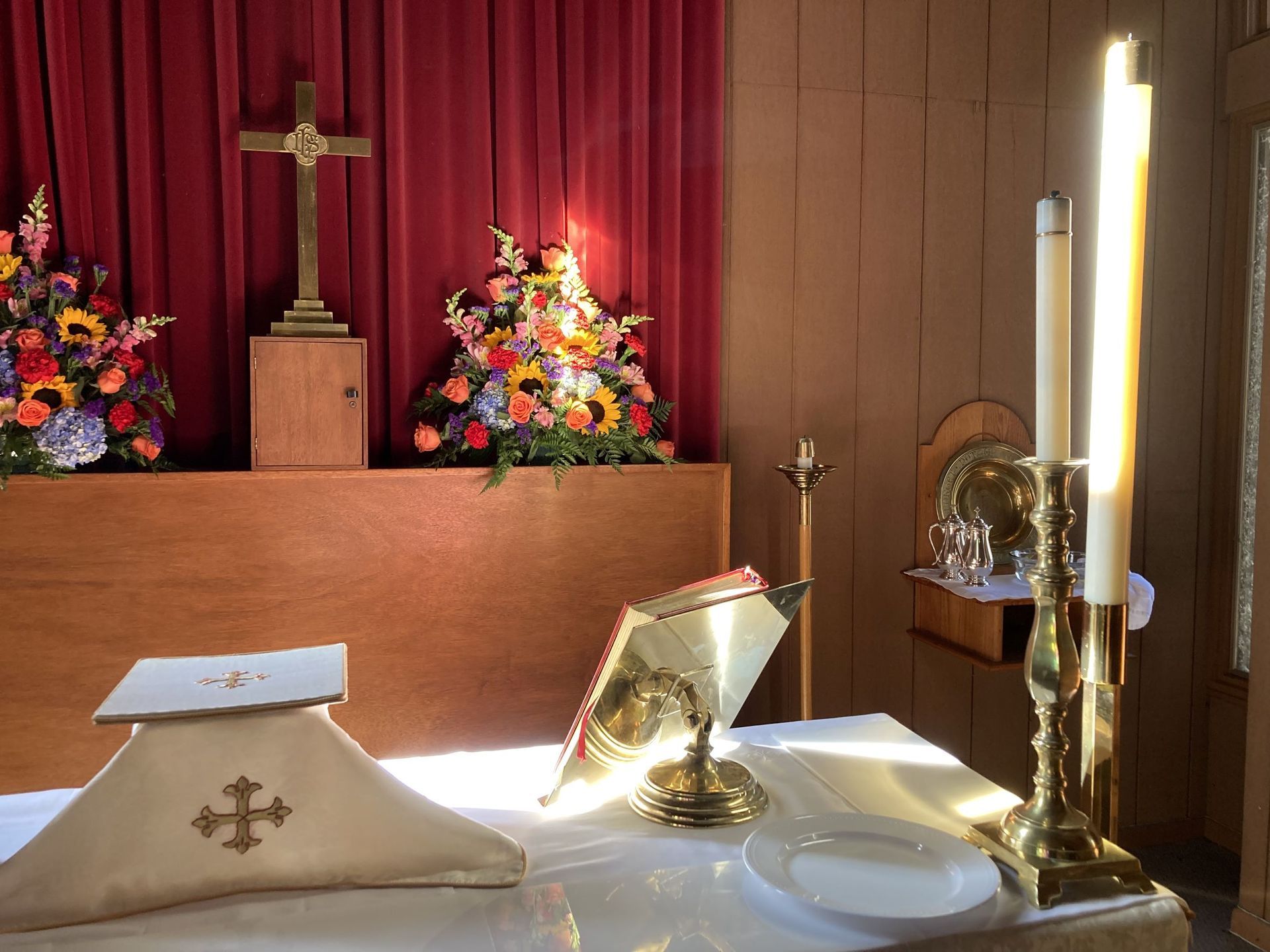
This Sunday, all are welcome to join us for a morning of worship and fellowship. Whether you are with us in the sanctuary or joining from afar, your presence strengthens our community. Our service is at 9:30 a.m. We warmly welcome those who cannot attend in person to join us via our live stream.

It escaped my notice, so perhaps it escaped yours as well. Back on August 31, the lauded poet, farmer, essayist, and deeply influential thinker Wendell Berry died at the age of 92, in the place he loved best, his farm in Kentucky. Over the years, several of our conversations have been inspired by or touched on Berry's ideas and writings. While Berry has influenced countless Christians through his poetry and fiction, he described himself as a "bad-weather churchgoer." In the preface to his collection of sabbath day poems titled "This Day," Berry explains it this way: "But I am a bad-weather churchgoer. When the weather is good, sometimes when it is only tolerable, I am drawn to the woods on the local hillsides or along the streams… In such places, on the best of these sabbath days, I experience a lovely freedom from expectations — other people’s and also my own. I go free from the tasks and intentions of my workdays, and so my mind becomes hospitable to unintended thoughts: to what I am very willing to call inspiration.." One of the things this quote brings to mind is how important the concept of "place" was in Berry's work and, more importantly, the way he saw the world and how he sought to live in it. Way back in 2017, we talked about the idea of place, with Berry as our guide. "Belong to your place by knowledge of the others who are your neighbors in it ..." This is a very small portion of Wendell Berry's "A Poem on Hope". In his poem, "The Want of Peace," reprinted in the illustration above, Berry writes: "I lack the peace of simple things. I am never wholly in place." So in our conversation this week we're going to revisit this idea of "place," of finding it, belonging to it, and perhaps losing it. There are many ways we can think about this notion. Where do we find peace? Where do we find God? Where do we find ourselves? Where do we find our people, or our purpose? Join us for the conversation tomorrow evening, Tuesday Oct. 6 starting at 7pm at Irish Tavern in downtown Lake Orion.
This Sunday, all are welcome to join us for a morning of worship and fellowship. Whether you are with us in the sanctuary or joining from afar, your presence strengthens our community. Our service is at 9:30 a.m. We warmly welcome those who cannot attend in person to join us via our live stream.

You're probably aware of this already, but for years now, we've been hearing that Americans in particular are suffering from an epidemic of loneliness. Which is different from simply being alone. I think we're all aware that it is perfectly possible crave alone time without feeling lonely, and to feel intense loneliness even when surrounded by people. Sometimes this can be a result of things that are out of our control. But often, it's the choices we make in the name of convenience that lie at the heart of this. Journalist Gabe Bullard's new book, "Against Convenience," argues that our pursuit of ever faster and frictionless experiences comes with invisible costs, and that we unthinkingly accept those as the inevitable price we have to pay to make things easier, Reviewing the book in The Atlantic , writer Julie Beck argues that many of those costs are social. Beck writes: "Once you open your eyes to the tradeoff between convenience and community, you start seeing it everywhere. It’s more convenient to ride a Peloton bike at home alone than to go to a spin class full of other sweaty bodies (whom you might end up chatting with). Zoom meetings make working with distant colleagues much easier, but aren’t very socially nourishing. The gig economy is rife with this bargain. Ubers and Lyfts replace rides given by friends and trips taken on public transit. Delivery replaces meals out at local restaurants and time spent in stores of all kinds." Sometimes, she continues, the whole point of an innovation is that it allows you to do something in isolation that once required interaction with others. Think self-checkout at the grocery store, or the "quiet ride" option that Uber introduced. One of the things we regularly talk about in our conversations is the importance of community. It's why some of us come to church, or, for that matter, Pub Theology. But I think we all also recognize that we engage in this tradeoff of convenience over community all the time, and in all kinds of ways. So that's what we're going to talk about in our discussion this week. Thinking about your life, your-day-to-day, how do you experience this convenience vs. community dynamic? Sure, when we're streaming a new movie in our living room, we're trading that for sitting with a bunch of strangers in an actual theater. Or when we get our meals or groceries or other purchases delivered to our door we get to spare ourselves the hassle of interacting with wait staff and cashiers, or dodging around other shoppers blocking the cereal aisle. But what about the impact of convenience on the relationships we really care about? And what is the impact of avoiding interaction, not just on ourselves, but on society?Finally, how much convenience are you willing to give up in order to build, or rebuild, or sustain community? Join us for the discussion tomorrow evening, Tuesday Sept. 29, starting at 7pm at Irish Tavern in downtown Lake Orion.
This Sunday, all are welcome to join us for a morning of worship and fellowship. Whether you are with us in the sanctuary or joining from afar, your presence strengthens our community. Our service is at 9:30 a.m. We warmly welcome those who cannot attend in person to join us via our live stream.

Years ago, when we were newly married, my wife and I used to schedule annual "planning retreats," where we'd leave town for a long weekend to stay in some charming bed and breakfast somewhere (typically coastal New England), enjoy what the local area had to offer, and to make plans for the future. We'd usually dedicate half a day or so of our getaway to thinking about and writing down our goals for the near and longer-term. These were the days before house and kids, when it looked like the future was ours to determine. We both had demanding jobs at the time, and while we weren't rolling in dough, we had enough to give us the luxury of looking ahead rather than worrying about how we were going to manage day to day. So we talked over timelines, savings goals, family priorities, and so on, trying to figure out things like how much we had to put away, and for how long, before we could start looking for a house. When would we be able to afford to have children? What were our career goals? Where did we want to be five years from now, or ten years from now? And it wasn't just brainstorming. We. Made. Plans. We had targets. And objectives. And we tried to stick to those plans over the following year, reviewing and reevaluating at our next annual planning retreat. At some point, though, we stopped doing this. I can't remember the specifics about when or why we abandoned the exercise, but at some point we did. If I had to guess, I think I'd say we realized that life didn't conform to our nearly laid out agenda. Or, as Mike Tyson famously said, "Everybody has a plan until they get punched in the mouth." Or, in military parlance, "No plan survives first contact with the enemy." You may be wondering at this point where we're going with this, and how it relates to our first discussion after our long summer hiatus. Well, it turns out that scripture has a few things to say on the topic of worrying about and planning for the future versus trusting in God's goodness and care. Probably the best known example comes from Matthew's gospel, specifically 6:25-34 where Jesus is telling his followers not to worry about the future: "Therefore I tell you, do not worry about your life, what you will eat or what you will drink, or about your body, what you will wear. Is not life more than food and the body more than clothing?Look at the birds of the air: they neither sow nor reap nor gather into barns, and yet your heavenly Father feeds them. Are you not of more value than they? And which of you by worrying can add a single hour to your span of life?" He concludes with this: "So do not worry about tomorrow, for tomorrow will bring worries of its own. Today’s trouble is enough for today." I hear the objection. You're right, this is Jesus telling us not to worry about the future; he's not telling us to not to plan for it. And, in Luke's gospel (14:28-30), Jesus addresses this directly. "For which of you, intending to build a tower, does not first sit down and estimate the cost, to see whether he has enough to complete it? Otherwise, when he has laid a foundation and is not able to finish, all who see it will begin to ridicule him ..." For me, this poses a bit of a conundrum. Why plan for the future when everything is in God's hands anyway? But if we fail to plan ahead, things can go awry and we'll face the consequences of our own unpreparedness. So where is the balance here? Join us for the conversation this week as we take on the question of planning for the future. Are you a planner, or are you more a seat-of-the-pants kind of decision maker? Do you develop plans for the long-term, or is your focus more on the immediate? For example, if it's my turn to make dinner, I make a meal plan (usually). But I'm not in the five-year-plan business. At least not anymore. How about you. Come out to Irish Tavern in downtown Lake Orion tomorrow evening, Tuesday Sept. 22, and share your thoughts with us. Discussion begins at 7pm.
This Sunday, all are welcome to join us for a morning of worship and fellowship. Whether you are with us in the sanctuary or joining from afar, your presence strengthens our community. Our service is at 9:30 a.m. We warmly welcome those who cannot attend in person to join us via our live stream.
This Sunday, all are welcome to join us for a morning of worship and fellowship. Whether you are with us in the sanctuary or joining from afar, your presence strengthens our community. Our service is at 9:30 a.m. We warmly welcome those who cannot attend in person to join us via our live stream.

Recollection and Repetition
This Sunday, all are welcome to join us for a morning of worship and fellowship. Whether you are with us in the sanctuary or joining from afar, your presence strengthens our community. Our service is at 9:30 a.m. We warmly welcome those who cannot attend in person to join us via our live stream.