In Remembrance...
Recollection and Repetition
I was in Atlanta, in my second week of courses at Candler School of Theology, awash in my fervor to learn, to reflect, to explore the vast terrain of theological learning. We didn't have cell phones, or at least, we didn't have them to hand at all times and we didn't get constant alerts and updates. They were mostly for phone calls and limited text messaging.
We had prayed at the beginning of class for the "accident" that had come across the news just before class started. But we were not prepared for what we would find when we arrived at the student lounge. It was packed. It was silent. Our ebullient conversation fell in line with the silence as we surveyed the room and moved to the back, around the hushed and gathered crowd. Everyone was sitting, staring in the same direction. Most had a hand to their mouth, masking their suspended gasp, or a look of incredulity, or of deep pain. We cast our attention in the same direction. All of our eyes were searching the small screen--the only screen in the whole lounge--for some scrap of reality in what we were seeing. Smoke billowed from two towers in NYC. And then, as I slowly came to grasp what we were all watching, we heard words that have etched themselves in my memory: terrorist attack. We saw one tower collapse, and then the other. And we felt we could do nothing. Even prayer seemed an empty sort of gesture compared to the magnitude of what we were witnessing.
I remember. I remember the shock. I vaguely remember leaving that lounge. I think I went to Jiffy Lube on the way home and got an oil change. I don't remember the contours of every face I saw that day and in the few days after, but we looked each other in the eyes, and in the face of strangers we found recognition, solidarity without saying a word. It was as though the words of Lincoln had come to life in our very faces: "We must not be enemies."
The beauty of that common humanity dissipated in the days after. A jumble of news images, speculation, speeches--those days are hard to differentiate. Life went on. But the fear gripped us and embittered us. On The 700 Club Pat Robertson proclaimed that this was judgment on America for "allowing" homosexuality and other supposed social moral failings to flourish. One of our seminary professors preached at Chapel that it may just be God's judgment on American imperial exploitation and hubris. All of us wanted to do something. Some wanted to explain. Many wanted to lash. Nearly all grieved, if not someone we had lost, or someone still under the rubble, then the loss of our world. Something had slouched in from beyond the boundaries of our lived reality and stolen away a load-bearing part of our assumed safety. More terrifying still--we knew that the world we now lived in was closer to reality. It pushed many of us to our lesser angels, though it also summoned the courage and imperfect nobility of ordinary people and first responders, who put their lives in jeopardy to find those who were lost.
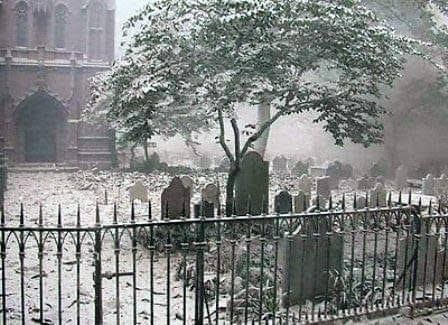
The work at Ground Zero gave purpose to the hands that moved the rubble and the lungs that inhaled and exhaled death so that strangers might live. But most of us had nothing to do with our hands. And the grief grew into anger. Our incensive spirit rooted, and in our stumbling through the days, we allowed it to turn into sublimated rage and latent violence. It would eventually boil over into war. And it was not enough to slake our thirst for safety.
Never forget, we say. Never forget. What is it we are not to forget? And what is that meant to do for us? Are we not to forget the thousands who died without ever stepping on a battlefield because of the rage of a few? Are we not to forget the desperation of those trapped in the towers, making impossible choices between the inferno and the window? Are we not to forget that we once lived in what we assumed was a safer world and that it was taken from us? Are we not to forget that we must be enraged and embittered by what happened to us? Are we not to forget what drove the architects of the attack to such monstrous acts? Are we not to forget how powerless we felt, with the unspoken vow never to feel so powerless again?
Remembering, in and of itself, is no virtue. If we are determined never to forget, we need to understand what it is we mean by remembering, what is we are committed to remembering, and why?
Remembrance is also at the heart of our faith. The Greek concept of anamnesis, recollection, was a point of popular philosophical reflection. In Plato's view, the act of recollection is what it meant to connect, or re-connect to what is most real. How is it that we have access to all that is good, true, and beautiful? How is it that mortals have the capacity to understand the eternal realities? Plato's answer, and that of other popular philosophers, was that we were descended from such eternal realities, and to them we return. The difficulty is simply that we have "forgotten" what is most real. And so our task is to remember or recollect our original state.
Remembrance is also crucial to the Jewish faith. The remembrance of God's mighty acts is central to the Shabbat services, to Passover, to Rosh Hashana and Yom Kippur and Hanukkah. This week on Sunday's service we'll read the story of the parting of the Red Sea and God's liberation of God's people. Psalms 78, 105, and 106 (among others) recount God's saving acts in the exodus.
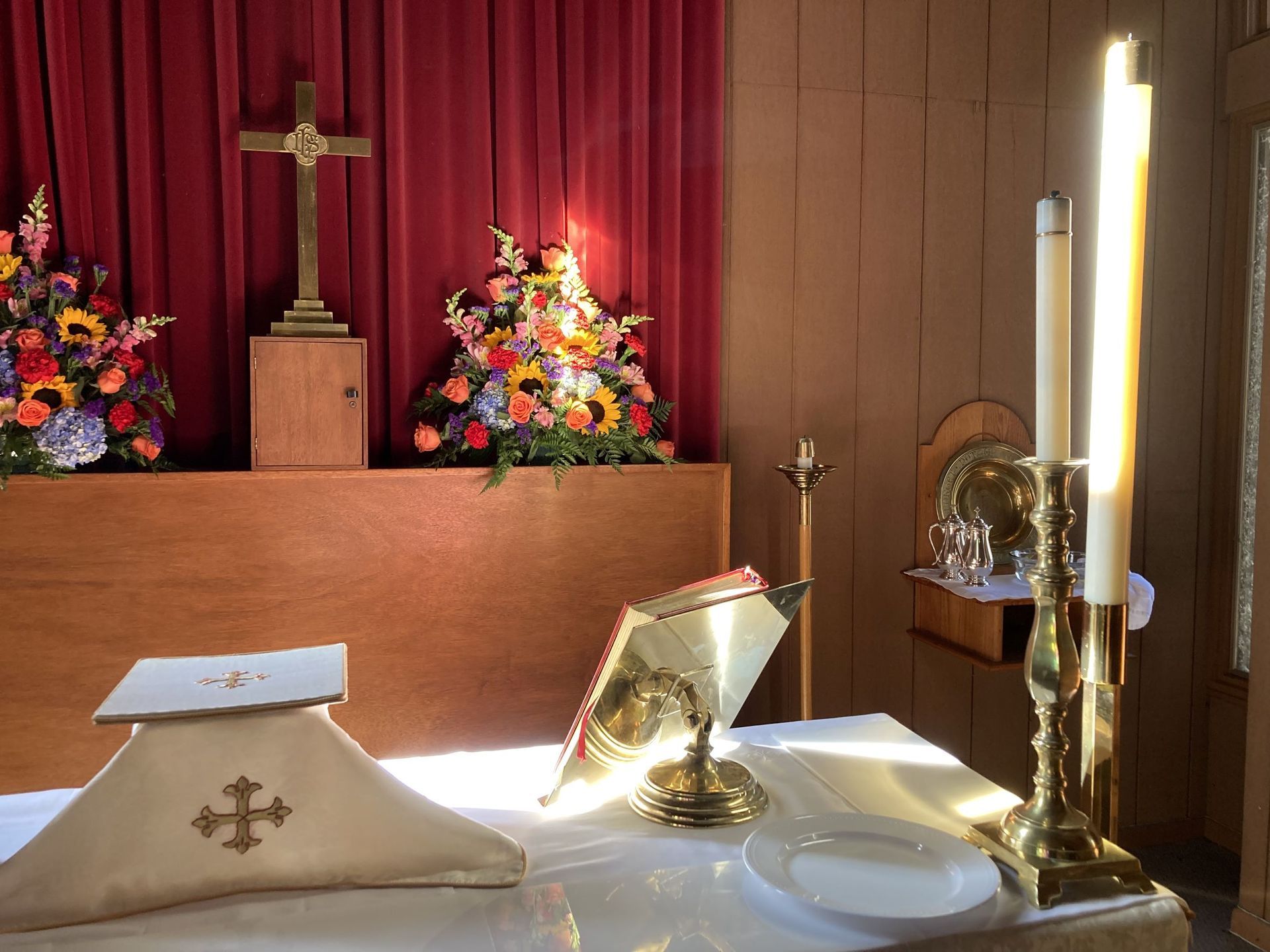
The remembrance of God's deeds found its center among the early Christians in the remembrance of God's saving work leading to Jesus. We remember that God made us in God's own image, that God called a people to be God's own people, that God spoke to us through the prophets and called us to return to God when we wandered far in a land that was waste. And we remember that God came among us, in the flesh, to redeem us and bring us home. We then specifically remember the Jesus in the bread and the wine in Jesus's own words: "Take, eat..."; "Drink this, all of you..."; "In remembrance of me."
What we remember in the Eucharist is not the trauma of our ancestors' slavery or of their exile or of Jesus's monstrous crucifixion. We remember that in the midst of this grief, pain, and woundedness, Jesus became the wound of God that heals the world. We remember that we were unable to stifle our own rage and fragmentation, but the God of Israel, the Living God, the Love that is God became us to show us how to be whole again.
It is possible to get stuck in remembrance in a way that brings us nothing but pain, sorrow, rage, and war. But it is also possible to remember anew that we must not be enemies, that, in fact, life is precious, and that we all are of one family. It is possible to remember the lives lost, not so that we feel compelled to avenge them, but so that we are compelled to honor them with the courage to wage peace, to replace exploitation with reconciliation, to replace domination with cooperation, to replace alienation with filiation.
Perhaps in remembering 9/11, then, we might remember how much our lives depend on each other. Perhaps we might remember not the monstrous deeds of a few, but the beauty of the lives that were lost, and the heroic courage of the ordinary, fragmented humans who placed their lives in peril to secure the lives of others. We can choose to remember their sacrifice. We can choose to remember our common humanity.
And in doing so, we might yet be changed. In an important essay on recollection in ancient Christianity, the New Testament scholar Nils Dahl examines the theme of recollection among the early Christians. He points to 2 Timothy 2:8: "Remember Jesus Christ, risen from the dead, descended from David, as preached in my Gospel." As Dahl writes, "To 'remember Jesus Christ' does not mean to preserve in memory an image of him but to let this memory form our thoughts and actions" (Nils Dahl, "Anamnesis," p. 20).
This is what the philosopher Søren Kierkegaard called "repetition" instead of recollection. Recollection, Kierkegaard says (writing under the name of Constantin Constantius), is distinguished from recollection. "Just as [the Greeks] taught that all knowing is a recollecting," Kierkegaard wrote, "modern philosophy will teach that all life is a repetition." Repetition and recollection are the same thing, "except in opposite directions, for what is recollected has been, is repeated backward, whereas genuine repetition is recollected forward." Recollection, in this view, makes us unhappy, whereas repetition makes us happy--that is, well.
Repetition is the kind of recollection that makes the past present in an effective way; it is the kind of recollection that does not trap us in the past, but opens up a future bigger than the past. When Christians remember, we remember only in ways that will open us to hope, faith, and love. If and when Christians says, "Never forget," we mean, never forget that all the lives lost in our spirals of recrimination and violence are not lost to God. We mean never forget that in the midst of death we are in life. We mean never forget that God has made a ways in the wilderness before and is doing it still. We mean never forget that we were made for God, made for each other, made for love. We mean never forget that God is faithful, We mean never forget that we belong to the living God in Jesus and that God raises up what was cast down and makes all things new, opening the means to live as God's own children.